
What Is a Content Pillar? How to Turn One Video Shoot Into a Month of Posts

A content pillar is one of a small number of core themes that everything your brand posts belongs to. Most businesses work with three to five of them, such as “how we do it”, “customer stories” and “tips for your industry”, and every post, video or caption sits under one. So when people ask what is a content pillar, the short answer is: it’s the filing system that stops your social media from being random.
The useful part is what happens when you plan a video shoot around those pillars. Instead of filming one promo and hoping it lasts, you come away with a month of posts that already fit a plan. Here’s how it works.
What is a content pillar, in plain English?
Think of your social channels as a magazine. A magazine doesn’t publish whatever turns up; it has regular sections. Content pillars are your sections. Each one has a clear job:
- It serves a purpose, such as building trust, teaching something, showing personality or selling.
- It suits a particular audience need, so people know what they’ll get from following you.
- It repeats, so you can make it as a series rather than starting from a blank page every week.
Social media management tools such as Sprout Social describe pillars in the same way: a handful of consistent themes or content types that hold up your whole strategy. Too many and the message gets diluted; too few and your feed gets repetitive.
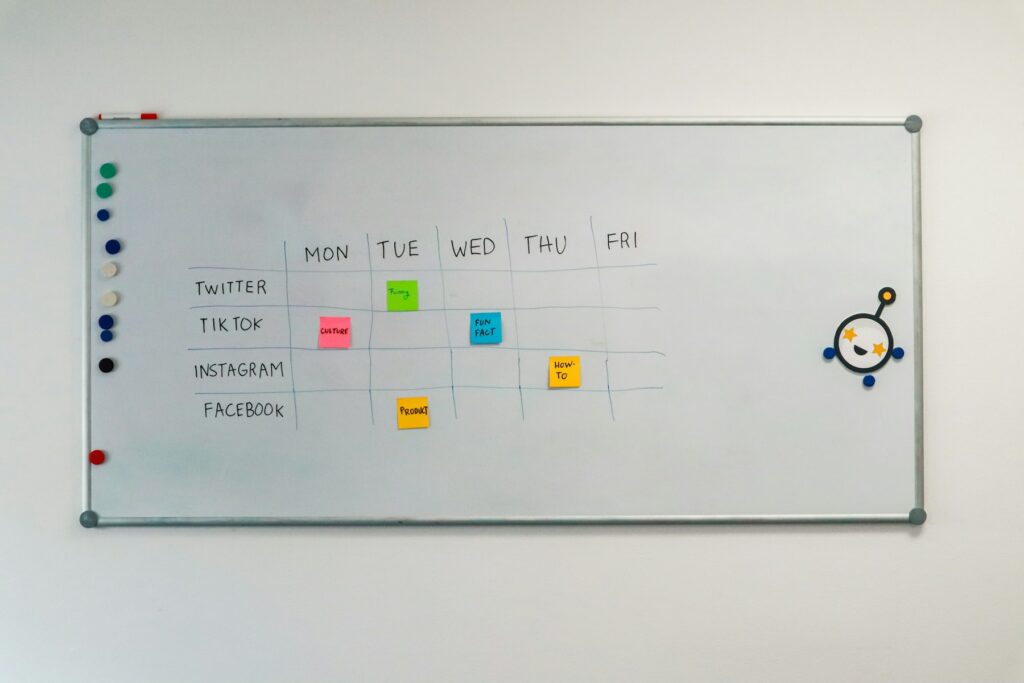
Content pillars vs pillar pages: don’t mix them up
You’ll also see “pillar” used in SEO, and it means something slightly different.
| Social content pillar | SEO pillar page | |
|---|---|---|
| What it is | A recurring theme for your posts | A long web page covering a broad topic |
| Where it lives | Instagram, TikTok, LinkedIn, YouTube, Facebook | Your website |
| What it connects to | Lots of individual posts and videos | Shorter “cluster” articles that link back to it |
| Main goal | Consistency, recognition and engagement | Search visibility and an organised site structure |
The two can work together. A video made for one of your social pillars can also be embedded in the matching page on your website, which is a tidy way to get more value from the same footage.
Common content pillar examples for UK businesses
Most pillars fall into a few familiar types. Pick the ones that suit your business rather than trying to cover all of them.
- Education: tips, how-tos, myths busted, answers to the questions customers always ask.
- Behind the scenes: your workshop, your kitchen, your team setting up on site, the process people never see.
- Proof: customer testimonials, case studies, before-and-afters, finished projects.
- People and culture: meet-the-team clips, day-in-the-life videos, recruitment content.
- Product or service: demos, launches, offers and clear calls to action.
- Community: local events, charity work, partners and user-generated content.
A local builder might choose education, proof and behind the scenes. A café might pick product, people and community. A B2B tech firm might lean on education, proof and culture. The point is that each pillar should be something you can keep producing for months.
How to choose your content pillars
1. Start with what customers ask
List the questions you answer on the phone, in emails and at the counter. Those questions are ready-made education content, and they tell you what your audience actually cares about.
2. Look at what you’re already good at showing
If your process is interesting to watch, behind the scenes is an obvious pillar. If you have happy customers who’ll talk on camera, proof is a strong one.
3. Match each pillar to a business goal
Awareness, trust, enquiries and recruitment all need different content. If a pillar doesn’t support a goal, drop it.
4. Keep it to three to five
Fewer pillars are easier to film, easier to schedule and easier for followers to recognise. You can always add one later.
5. Write a one-line brief for each
For example: “Education: 30–60 second tips that answer one customer question each, filmed to camera.” That one line makes it far easier to plan a shoot.
How to turn one video shoot into a month of posts
This is where content pillars pay for themselves. When you know your pillars before filming, a single shoot day can be planned to feed every one of them. Here’s an approach that works.
Before the shoot
- Write a shot list per pillar. For education, list the tips you’ll film to camera. For behind the scenes, list the processes worth capturing. For proof, line up a customer or two for short interviews.
- Decide on formats. Short-form platforms such as Reels, TikTok and YouTube Shorts favour vertical 9:16 video, while standard YouTube videos and website embeds usually suit 16:9. Planning this up front means framing shots so they can be cropped for both.
- Batch the talking. Get every piece to camera done in one sitting while the presenter is warmed up, then move on to the action shots.

On the day
- Film the pieces to camera first, then the process, then the people.
- Capture plenty of b-roll: hands at work, details, wide shots of the space. It fills gaps across every pillar.
- Take stills during the shoot as well, so photo posts and carousels match the video.
In the edit
A well-planned shoot day can be cut into something like this:
| Pillar | What you get from the footage | Example posts |
|---|---|---|
| Education | Several short tips filmed to camera | One tip a week as a Reel, Short and LinkedIn video |
| Behind the scenes | Process clips and b-roll | “How it’s made” montages, time-lapses, Stories |
| Proof | A customer interview | A full testimonial plus short quote clips |
| People | Team introductions | Meet-the-team series, recruitment posts |
| Product or service | Demo footage and stills | A hero promo cut down to 15 and 30 seconds |
Spread across a month, that is enough to post several times a week without anything feeling repeated, because each pillar comes round in rotation. The exact number of posts depends on how long the shoot is and how much you plan, so be realistic rather than chasing a headline figure.
Mistakes to avoid
- Pillars that are too vague. “Inspiration” isn’t a pillar unless you know what you’ll actually post under it.
- Only selling. If every pillar is promotional, people stop watching. Most brands mix in education and personality.
- Filming without a plan. Turning up with a camera and no shot list usually produces lots of footage and very few usable posts.
- Ignoring the numbers. Check which pillars get watched, saved and shared, and adjust every few months.
Need help filming content for your pillars?
We plan and film social content for businesses across Suffolk, Essex, Cambridgeshire, Norfolk and London, then cut the footage into short-form edits for each platform. Read our guide on how to create a month of social media content in one filming day, see how we handle social and short-form video editing and format versions for every platform, or get in touch to talk through your pillars.
Frequently asked questions
How many content pillars should a business have?
Three to five is the usual range. It gives you variety without making your feed feel scattered, and it keeps planning and filming manageable.
Are content pillars the same as content buckets?
Broadly, yes. “Content buckets”, “content themes” and “content pillars” are often used to mean the same thing: the categories every post belongs to.
Can content pillars change?
They should be stable enough to be recognisable, but it’s sensible to review them every few months and swap out any pillar that isn’t supporting a goal.
Do content pillars have to be video?
No. A pillar is a theme, not a format. Video, photos, carousels and text posts can all sit under the same pillar, and mixing formats keeps things fresh.