
Best Places to See Northern Lights in the UK (and How to Photograph Them When You Get There)
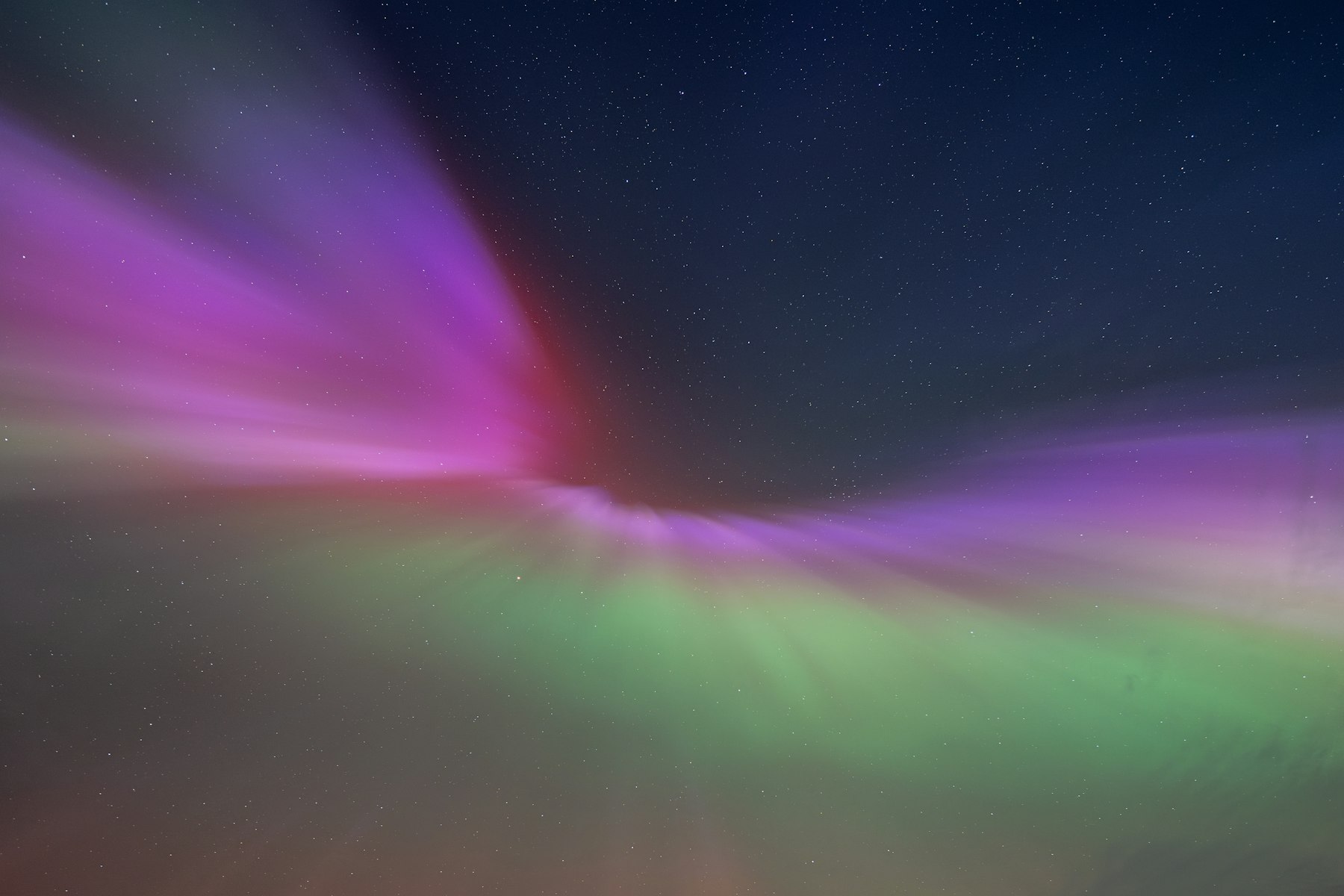
The best places to see northern lights in the UK are dark, north-facing spots as far north as you can get: Shetland, Orkney and the north of Scotland first, then dark sky areas such as the Cairngorms, Galloway Forest, Northumberland and the Yorkshire Dales. During strong displays the aurora has been seen and photographed much further south too, including Wales, the Peak District and southern England.
Below we cover the best places to see northern lights across the UK, how to know when it’s worth heading out, and the camera and phone settings that give you the best chance of a great photo.
Why location matters so much
The aurora is caused by charged particles from the Sun hitting the upper atmosphere. It forms in an oval around the magnetic pole, so the further north you are, the more often it reaches overhead or sits high enough above the northern horizon to see. From most of the UK you are looking north at the edge of that oval, which is why three things matter more than anything else:
- Latitude: the further north, the better your odds.
- Darkness: light pollution from towns washes out faint displays. Dark sky parks and reserves are ideal.
- A clear view north: a low, open northern horizon, such as a coastline, loch or hilltop, beats a valley with hills in the way.
The best places to see northern lights in the UK
| Location | Region | Why it’s good |
|---|---|---|
| Shetland and Orkney | Northern Isles, Scotland | The most northerly parts of the UK, with the best odds. Locally the aurora is called the “Mirrie Dancers” |
| Tomintoul and Glenlivet, Cairngorms | Highlands, Scotland | An International Dark Sky Park since 2018, inside Cairngorms National Park |
| Isle of Coll | Inner Hebrides, Scotland | A designated Dark Sky Island with almost no artificial light |
| Galloway Forest Park | Dumfries and Galloway, Scotland | The UK’s first Dark Sky Park. Clatteringshaws Loch and Loch Doon are popular viewing spots |
| Northumberland International Dark Sky Park | North East England | Covers Northumberland National Park and Kielder Forest. The aurora has been seen over Hadrian’s Wall |
| Yorkshire Dales | North Yorkshire | A Dark Sky Reserve since 2020, with dark moorland around places such as Ribblehead |
| Derwentwater | Lake District, Cumbria | Displays have occasionally been seen reflected over the lake |
| Eryri (Snowdonia) | North Wales | Wild, dark mountain terrain such as the Carneddau |
| Bannau Brycheiniog (Brecon Beacons) | South Wales | Wales’s first Dark Sky Reserve. The western and northern edges are darkest |
| Mam Tor | Peak District, Derbyshire | A 360-degree summit view, with occasional sightings during strong displays |
Scotland: your best odds
If you want the best chance, head to Scotland. Its latitude means it sees the aurora more often than anywhere else in the UK, and the north and north-east coasts give you a big open sky over the sea. Shetland and Orkney are the stand-outs. On the mainland, the Cairngorms and the far north coast are good bases, and Galloway Forest Park in the south-west is easier to reach from England.
Northern England
Northumberland’s dark sky park, which includes Kielder Forest and Kielder Water, is the most famous dark sky area in England, with an observatory and several stargazing centres. The Yorkshire Dales and the Lake District are also good options when activity is higher.
Wales and further south
Wales has excellent dark skies in Eryri and Bannau Brycheiniog, plus coastal spots in Pembrokeshire. During the very strong display in May 2024, people photographed the aurora across almost the whole UK. Displays like that are rare, but they show that a dark spot with a clear northern view can work surprisingly far south when the alerts are high.
When to go and how to know it’s worth it
The aurora can’t be booked like a sunset, so the trick is to watch forecasts and be ready to move.
- Season: autumn and winter give you long, dark nights. In midsummer, Scotland barely gets properly dark, so even a good display can be hard to see.
- Time of night: the darkest hours, roughly 10pm to 2am, are a good window, though activity can come at any time once it’s dark.
- Moon: a bright moon washes out faint aurora. Nights around the new moon are best.
- Cloud: the strongest display is no good under cloud. Check the weather forecast as carefully as the aurora alerts.
Aurora alerts to follow
Two free UK sources are worth bookmarking. AuroraWatch UK, run by Lancaster University, issues colour-coded alerts based on magnetometer readings:
- Green: no significant activity.
- Yellow: minor activity. The aurora may be visible by eye in Scotland, and by camera in Scotland, northern England and Northern Ireland.
- Amber: possible aurora. Likely visible by eye in Scotland, northern England and Northern Ireland, possibly elsewhere, and likely photographable from anywhere in the UK.
- Red: aurora likely to be seen by eye and camera from anywhere in the UK.
The Met Office also publishes a space weather forecast, which gives you a heads-up a day or two ahead when a solar eruption is heading our way.
Is it too late after solar maximum?
The Sun runs on a roughly 11-year cycle, and the peak of the current cycle is thought to have come around late 2024. Activity is now in the declining phase, which means fewer events overall. But strong individual storms still happen, and some of the biggest historic displays came after the peak, so it’s still well worth watching the alerts this winter.
How to photograph the northern lights
One thing surprises many people: cameras often see more of the aurora than your eyes do. A faint grey glow to the eye can show up green and pink in a long exposure. So even on a “maybe” night, it’s worth taking a test shot to the north.
Kit to take
- A camera with manual controls, or a recent phone with a night mode
- A wide, fast lens, ideally with an aperture of f/2.8 or wider
- A sturdy tripod (a small one for a phone)
- Spare batteries, as cold drains them quickly
- A head torch with a red light, warm layers and a flask
Starting camera settings
| Setting | Starting point | Adjust if |
|---|---|---|
| Mode | Manual, shooting RAW | RAW gives you much more room to fix colour and noise later |
| Aperture | As wide as your lens allows, around f/1.4 to f/2.8 | Stop down slightly if stars at the edges look smeared |
| ISO | 1600 to 3200 | Raise it if the image is too dark; lower it if it’s very noisy |
| Shutter speed | About 5 seconds for a moderate display | 1 to 5 seconds for fast-moving curtains; 10 to 20 seconds for a faint, slow glow |
| Focus | Manual, set on a bright star | Recheck during the night, as focus can drift |
To focus, switch to manual, zoom in on a bright star in live view and turn the focus ring until it looks as small and sharp as possible. Don’t trust the infinity mark on the lens on its own. Take a test shot, check it zoomed in, then change one setting at a time.
Using a phone
Modern phones can capture the aurora surprisingly well. Use night mode, keep the phone still on a mini tripod or propped on something solid, and point it north. If the aurora is moving fast, a shorter exposure will keep the shapes crisper. Tap to focus on a distant light if your phone allows it.
Make the picture, not just the sky
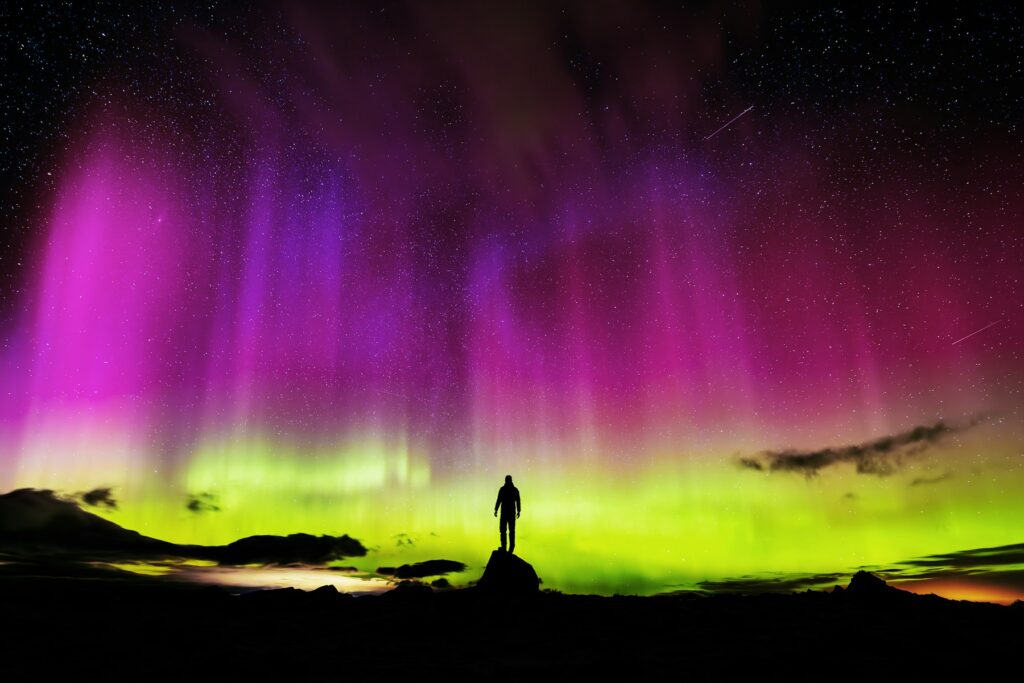
The photos people remember have a foreground: a loch reflecting the colour, a castle, a lighthouse, a tree on a ridge or a person silhouetted against the sky. Scout your spot in daylight if you can, so you know where to stand and what’s in the frame when it’s pitch black.
Want help with your own photography?
Night shoots are a great way to learn your camera inside out, and the right lens makes a real difference. If you want to try a faster wide-angle lens or a sturdier tripod before buying, we offer lens hire and tripod and grip hire. If you come home with a card full of aurora shots, our photo editing and retouching service can help with noise, colour and finishing. For anything else, get in touch.
Frequently asked questions
Where is the best place to see northern lights in the UK?
Shetland and Orkney give you the best odds, followed by the north of mainland Scotland. In England and Wales, dark sky areas with a clear view north, such as Northumberland or Eryri, are your best bet when alerts are high.
Can you see the northern lights in England?
Yes, during stronger displays. Northern England sees it more often, but in big events such as May 2024 it was photographed across most of the country.
What time is best to see the northern lights?
The darkest hours, roughly 10pm to 2am, are a good starting point, but keep an eye on alerts as activity can pick up any time after dark.
Why does the aurora look brighter in photos than in real life?
A camera collects light over several seconds and records colour that the human eye struggles to see in the dark, so a faint glow can look much more vivid in a photo.