
Corporate Video Interview Questions That Get Better Answers
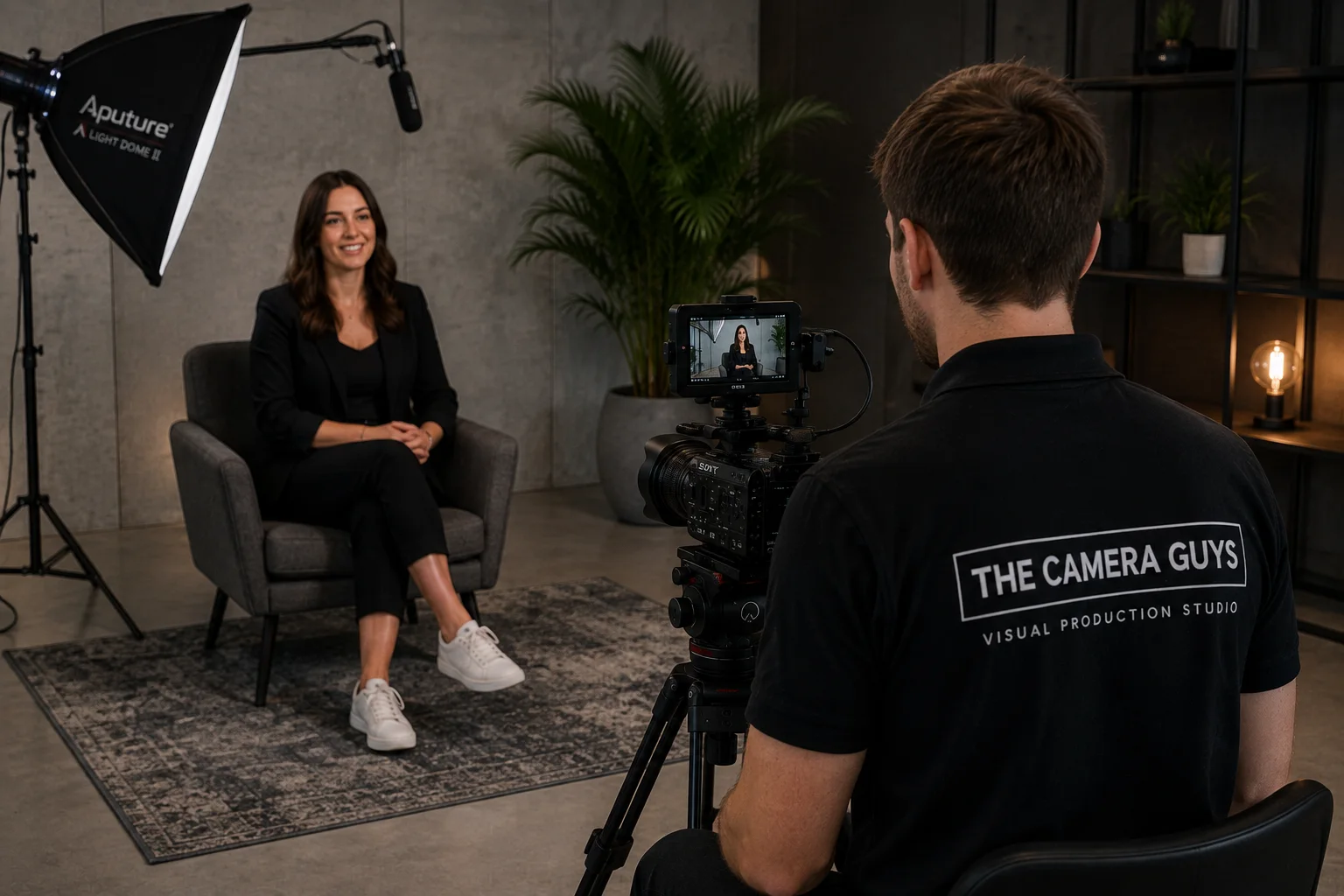
The best interview question is often not the one you wrote down.
You ask:
“What makes your company different?”
They answer:
“It’s our people, our service and our attention to detail.”
Nothing is technically wrong with that answer.
It is also almost impossible to build an interesting film around it.
So you ask:
“What do your team actually do that a customer might never see?”
Now you have somewhere to go.
A useful corporate interview is less about having a brilliant list of questions and more about knowing what the film needs to discover, then following the answers far enough to get something specific.
That is the difference between an interview that sounds like marketing copy and one that gives the editor a story.
Build a route through the conversation, not a questionnaire
Before writing questions, decide what the contributor is actually there to help explain.
For a short company film, you might need four things:
The problem
What does the customer or audience need help with?
The process
What does the business actually do about it?
The evidence
What real example, decision or result makes that believable?
The next step
What should somebody understand or do afterwards?
That gives you a route.
It does not mean you need exactly four questions.
One answer may cover two parts. Another may reveal something much better than anything you prepared.
The interviewer’s job is to notice that and follow it.
Our guide to planning a corporate video starts with the same principle: decide what the viewer needs to understand before deciding how the film will say it.
Start with something the person can answer without performing
Do not open with:
“Tell us about yourself.”
That can make an ordinary employee feel as if they need to produce a polished biography on command.
Start somewhere easier.
“What part of the work do you look after?”
Then:
“What does that involve on a normal day?”
You may never use either answer in the final film.
That is fine.
Those first minutes help the contributor settle into the conversation and help the interviewer learn how they naturally describe their work.
You also start hearing the useful vocabulary.
A technical specialist may use a phrase that needs explaining. A project manager may mention a part of the process you had not realised was important. An employee may describe a task that would be worth filming afterwards.
That is why we do not treat the interview sheet like a script.
The follow-up question is usually where the useful answer appears
Suppose somebody tells you:
“We are very focused on quality.”
You could move to the next question.
Or you could ask:
“What do you actually check before the job leaves the workshop?”
They explain an inspection.
Then:
“What happens if it fails that check?”
Now the film has a process, a decision and something the camera may be able to show.
That second or third question is often where the generic corporate language disappears.
Useful follow-ups include:
- Can you give me an example?
- What happened next?
- Why did that matter?
- How did you know it had worked?
- What would that look like in practice?
- Can you show me the part you mean?
- What usually goes wrong there?
- What would somebody unfamiliar with this need explained?
Do not fire all of them at once.
Ask one.
Listen.
Then decide whether the answer needs another question.
Ask for decisions, not values
Businesses often want films to communicate things like quality, innovation, collaboration and customer service.
The problem is that asking directly about those values usually produces the least interesting answers.
Question:
“Why is customer service important to you?”
Likely answer:
“Because our customers are at the heart of everything we do.”
Instead, ask for a decision.
“Can you remember a time when a customer needed something outside the normal process?”
or:
“What happens when a customer calls with something urgent?”
Now the contributor has to talk about what people did.
If the company really behaves in a customer-focused way, the example should demonstrate it without requiring anybody to say the phrase “customer-focused”.
The same technique works for almost every abstract claim.
Instead of:
“Why are you innovative?”
Try:
“What have you changed in the last year because the old way was not good enough?”
Instead of:
“Why is teamwork important?”
Try:
“Which other part of the business do you rely on when a difficult job comes in?”
Instead of:
“Why are you passionate about quality?”
Try:
“What is something you would refuse to send to a customer?”
The second version gives the editor something concrete.
For the person who actually does the work
This is often the most overlooked interview in a corporate film.
The person doing the job can usually explain details that senior management simply does not encounter every day.
For a manufacturer, technician, operator, designer, engineer or service team member, a useful route might be:
“What happens when a new job first reaches you?”
Then:
“Which part needs the most judgement?”
Then:
“What are you looking for before you are happy to move it on?”
Then, if they mention something interesting:
“Can you give me a recent example?”
You can also ask:
- What is the part customers rarely see?
- What is easy to get wrong if you do not know the process?
- What do you check twice?
- What changes from one job to another?
- What have you learned to notice that a new starter might miss?
- What happens when something does not go to plan?
These questions do more than create interview material.
They can generate the supporting footage.
If somebody says the most important part of the job is a particular inspection, we now know that inspection deserves camera time.
For a founder or senior leader, avoid the company-history recital
Founders are often given the broadest possible questions:
“Tell us how the company started.”
“What are your values?”
“Where do you see the business in five years?”
Those answers can be useful, but they can also produce several minutes of material that never reaches the final edit.
A better starting point is often the decision behind the business.
“What problem did you keep seeing that made you think there was a better way?”
From there:
“What did you get wrong at the beginning?”
“What has changed most about what customers need?”
“Which part of the business have you deliberately refused to compromise on?”
“What are you trying to make easier for customers now?”
A senior contributor is most useful when they can provide context, judgement and direction — not simply recite the About page.
If the company’s history genuinely matters to the film, ask for the moment that changed something rather than every year since incorporation.
For a technical specialist, make the interviewer the confused person
Technical interviews become difficult when everybody in the room understands the subject except the eventual viewer.
The specialist says something completely normal to them.
The interviewer nods.
The editor later realises nobody has explained what it means.
It is perfectly acceptable to ask:
“Can you explain that without using the acronym?”
or:
“What does that actually do?”
or:
“If I knew nothing about this system, what would I notice when it is working correctly?”
Useful technical questions include:
- What goes into this process, and what comes out?
- What has to happen before this stage can begin?
- What tells you the result is acceptable?
- Which part is measured rather than judged?
- What is the term people most often misunderstand?
- Which claim can we actually demonstrate on camera?
- Which figure needs checking before we put it in the film?
Write down unfamiliar names, units and terminology while you are there.
An editor should not have to guess whether somebody said power, energy, capacity or output because everyone on location understood what they meant.
For recruitment films, ask about the reality of the job
Recruitment interviews become useless when every employee says:
“No two days are the same.”
“Everyone is really friendly.”
“There are lots of opportunities.”
A candidate needs more than that.
Ask:
“What did you find hardest when you first started?”
“Who helped you learn it?”
“What does a genuinely busy day look like?”
“What are you better at now than when you joined?”
“What part of the job would surprise somebody applying from outside the industry?”
“What should somebody know before applying?”
Those answers can include challenge as well as praise.
That is useful.
A role where somebody occasionally has to solve difficult problems does not become unattractive because an employee admits that the problems exist.
It becomes easier for the right applicant to understand what they are signing up for.
For more on helping non-presenters feel comfortable, see our guide to making employees comfortable on camera.
Customer interviews are a different conversation
A customer testimonial may still be filmed as an interview, but the questions need to stay rooted in their actual experience.
That means asking about:
- the situation before they bought or commissioned anything;
- what they were concerned about;
- why they chose the supplier;
- what the process was actually like;
- what changed;
- and what they would tell somebody considering something similar.
Do not ask the customer to explain your company’s technical expertise if they are not qualified to do that.
Do not feed them your preferred marketing sentence.
And do not turn their qualified answer into a broader claim in the edit.
We keep that subject separate in our guide to filming a professional customer testimonial and our article on interview videos vs testimonial videos.
Give the answer enough context to survive the edit
If the interviewer will not be heard in the final film, the answer needs to make sense without the question.
Question:
“How long does that stage take?”
Answer:
“Usually about three days.”
Perfectly natural conversation.
Not very useful on its own.
You can simply ask:
“Can you give me that again and include what takes three days?”
Then:
“The testing stage usually takes about three days.”
You do not need every answer to become a formal full sentence.
You just need enough context for the editor to use it honestly.
The same applies to pronouns.
“They normally handle that for us.”
Who are “they”?
“That was the difficult part.”
What was?
The interviewer already knows because they asked the question.
The viewer will not.
Do not rescue every pause
Someone finishes a question.
The contributor looks away.
Two seconds pass.
The interviewer becomes uncomfortable and starts talking.
Unfortunately, the contributor was about to answer.
Give people thinking time.
Silence feels much longer when you are standing beside a camera than it does in the edit.
You can remove the pause later.
You cannot recover the answer you talked over.
The same applies at the end of an answer. Wait a moment before replying with “brilliant”, “yeah” or the next question.
That clean space makes the edit easier and avoids your encouragement becoming part of the audio every time.
Our interview videography is built around making that conversation feel calm rather than rushing contributors through a list.
Do not send somebody 25 questions to memorise
Contributors usually need to know the topics, not rehearse every answer.
Before the shoot, you might tell somebody:
We’ll talk about how you joined the company, what your role involves, a difficult project you learned from and what somebody should know before applying.
That gives them enough information to prepare mentally without encouraging them to write a speech.
There are exceptions.
A technical contributor may need exact figures available.
A regulated subject may need particular wording checked.
A senior spokesperson may need to know which areas are off limits.
That is different from asking everybody to arrive with scripted answers.
If the film genuinely requires exact wording, a scripted section or presenter-led format may be more appropriate than pretending it is a spontaneous interview.
The Sony × AMWORLD shoot is a good example of why the questions and footage belong together
For our Sony × AMWORLD corporate testimonial, Darren from Sony needed to explain a broad working relationship with AMWORLD covering areas including courier services, warehousing, fulfilment, campaigns, launches and international events.
The interview gave that relationship a human point of view.
The supporting footage gave the film somewhere to go visually.
During the London shoot, we also filmed Darren showing the visiting AMWORLD team around Sony Europe’s headquarters. That gave us purposeful interaction and a recognisable setting rather than asking people to stand around pretending to have a spontaneous office conversation.
The useful lesson is not “always film a tour”.
It is that the interview questions and the supporting footage should inform each other.
If somebody describes an important process, consider whether we can film it.
If the planned footage reveals something interesting, consider whether the interview should ask about it.
That is how the final film starts feeling connected rather than like an interview with random B-roll placed over the top.

A simple interview route you can actually take into the room
If you need something practical, use this as a starting point rather than a script.
1. Settle them in
What part of the work do you look after?
2. Find the subject
What problem are you usually helping to solve?
3. Get specific
Can you talk me through what actually happens?
4. Find the decision
Which part needs the most judgement?
5. Get an example
Can you remember a recent time when that mattered?
6. Find the consequence
What happened because of that decision?
7. Help the viewer
What would somebody unfamiliar with this need to understand?
Then stop looking at the list.
If answer three gives you the story the film needs, follow it.
A corporate interview should feel like a conversation with direction, not a verbal questionnaire.
The question sheet is not the finished film
You might record forty minutes with somebody and use ninety seconds.
That does not mean the other thirty-eight minutes were wasted.
The early answers help the person settle.
One explanation may give you the terminology you need for a later question.
A side comment may reveal the example that becomes the backbone of the film.
The interviewer is gathering options for the edit, not racing towards a predetermined quote.
That is also why the number of questions should come from the film you are making.
A short service film might need one problem, one process, one example and one useful conclusion.
A longer case study may need much more.
At The Camera Guys, our corporate video production includes interview planning as part of the production where the film needs it.
If you know the audience and what the interview needs to explain, send us that rather than a finished list of questions.
We can build the conversation around the story you actually need to get out of the room.