
Video Production in Ipswich: What to Consider Before Your Shoot

If you are making a video for a business in Ipswich, you do not automatically need a drone shot of the Waterfront.
You might want one. It can be a useful way to establish the location. But if the interesting part of your business happens in a workshop, warehouse, laboratory, office or somewhere twenty miles away, that is probably where the camera should spend most of its time.
The location should help explain the business, not simply prove that you are in Ipswich.
That sounds obvious. It is also one of the easiest things to lose sight of when planning a corporate film.
Start with what somebody needs to see
Imagine you run an engineering company with an office in central Ipswich and a manufacturing site outside town.
The office may be the easiest place to arrange an interview. It might have a smart meeting room, good access and a recognisable address.
But if the film is meant to help a customer understand what you actually make, the workshop is likely to be more valuable.
That does not mean every company video needs to become a factory tour. It means asking a simple question before choosing the locations:
What would be difficult for somebody to understand if we did not show it?
It could be a manufacturing process, a piece of equipment, the way a customer is looked after, what happens behind the scenes at an event or simply the people a client will actually deal with.
That answer should drive the filming plan.
Our guide to what makes a good corporate video goes further into that distinction between saying something and actually showing it.
Your Ipswich address does not have to be the filming location
One of our clients, Sentry, has its head office in Claydon, near Ipswich.
The films we made for them were not built around their head office.
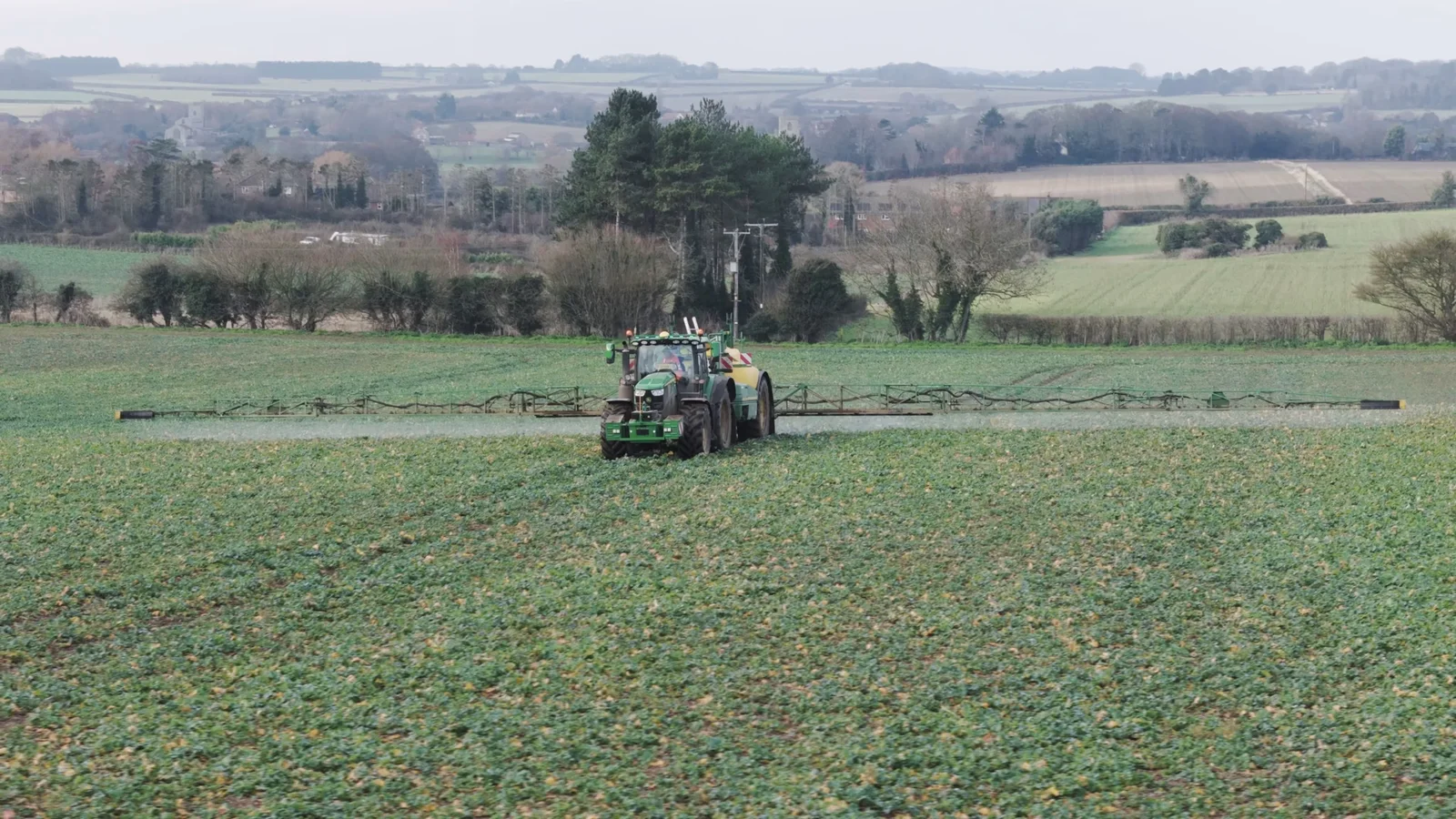
We filmed across working farms in Norfolk because that was where we could show the land, machinery, people and agricultural operations that the films were about. Ground cameras captured the practical work while drones showed the scale of the farms and surrounding landscape.
That was a much better use of the production than trying to make every shot geographically match the address at the bottom of the company website.
It is a useful principle for almost any business video: film where the interesting evidence is.
If your Ipswich office is where customers meet the team and important decisions happen, great — use it. If your work happens at customer sites, on construction projects or somewhere else entirely, the production can follow it.
Being based in Ipswich does not mean the entire film has to be made there.
What an Ipswich filming day might actually look like
Here is an illustrative example rather than a fixed production schedule.
Suppose a professional-services business wants a two-minute website film and several shorter clips. Its office is near Ipswich town centre, and one of its customers operates from a site a short drive away.
A sensible day could look something like this:
| Part of the day | What we are trying to capture |
|---|---|
| Morning at the office | Main interview, team working, client meetings, useful details of the workplace |
| Late morning | Additional short answers specifically intended for social or service-page videos |
| Afternoon at the customer site | Real examples of the service being delivered and, if appropriate, a customer interview |
| Before leaving | Missing shots, exterior material and anything the editor will need to connect the two locations |
Notice what is not automatically in there: an hour wandering around Ipswich collecting generic shots of buildings.
If the city itself matters to the story, include it. If it does not, that filming time may be better spent getting a stronger interview or showing something a prospective customer actually wants to understand.
The same principle applies when trying to film several videos in one day. The number of useful outputs depends on how much can share the same people, location and setup.
The Waterfront can work brilliantly — when it has a reason to be there
Ipswich Waterfront is an obvious visual location. The marina, old industrial buildings and newer development can give a film a strong sense of place.
For some businesses, that is genuinely useful.
A property company discussing a Waterfront development, an organisation promoting Ipswich as a place to work or an event happening there all have a clear reason to show it.
For somebody whose entire film takes place in an industrial unit elsewhere, an unrelated Waterfront montage may just be decoration.
There are practical considerations too.
Open water means wind can become a problem for an interview. Public activity changes through the day. The attractive angle you found during a quiet recce may be busy when the crew returns. Some spaces that feel public may be privately managed.
That does not make the Waterfront difficult to film. It simply means the exact plan matters.
If you only need a few establishing shots, they can often be treated as a small part of the production rather than moving the entire interview setup outside.
Public filming in Suffolk needs to be planned
For filming in public areas, Screen Suffolk operates the county's permit system through FilmApp.
Its current guidance says productions should apply for a filming permit regardless of crew size and requires proof of £10 million public-liability insurance for permission to film or carry out commercial photography in public areas.
You can check the current process on Screen Suffolk's filming-permit page.
That does not mean every camera inside an Ipswich business needs a council permit. Private premises have their own access arrangements, and the person or organisation controlling the property needs to agree the filming.
The useful question is not simply “Do we need a permit?”
It is:
Who controls the place where the crew and equipment will actually be?
Work that out before building an important scene around the location.
Find somewhere quiet before somewhere impressive
A boardroom overlooking the town might look excellent and sound terrible.
Before choosing the interview location, stand in the room and listen.
Can you hear the ventilation? Is there a fridge or coffee machine nearby? Does the room sit beside a corridor that becomes busy every half hour? Are there hard surfaces creating lots of echo?
A photograph of the room will not tell the production team any of that.
If possible, send a short phone video as well. Include the windows, the likely camera position and a few seconds of the natural room sound.
Often the best approach is to record the important conversation somewhere controlled and use other parts of the building for supporting footage.
The person speaking can concentrate on giving a useful answer rather than competing with traffic, wind or somebody making an espresso six feet away.
Our guide to filming natural corporate interviews explains how the interview and supporting footage can work together without everything happening in the same shot.


Moving location costs more than the journey time
Ipswich is compact enough that two locations can look very close together on a map.
That still does not mean the production moves instantly.
The crew has to stop filming, pack equipment, get it out of the building, load it, travel, park or unload, find the right entrance and set everything up again.
At a larger business site, signing in and completing an induction can add more time.
If the second location gives the film something important, that is usually time well spent.
If it gives you another meeting room that looks slightly different from the first one, it probably is not.
A useful pre-production plan groups filming sensibly so the day is spent capturing material rather than repeatedly rebuilding the same setup.

Decide what you need after filming
One filming day can produce much more than one finished video, but only if those outputs are discussed before the shoot.
Perhaps you need:
- a main film for the website;
- four short answers for LinkedIn;
- a customer testimonial;
- vertical versions for social media;
- captioned and clean versions;
- or a library of useful footage for future edits.
Those are different deliverables.
If a vertical edit matters, the camera operator needs to think about framing. If a short video needs to work on its own, the speaker may need to answer a question in a way that makes sense without the main film around it.
Do not wait until the edit to discover that the footage was framed for one format and commissioned for three.
Our video production brief guide will help you put those outputs on paper before anyone starts filming.
What should you send when asking for a quote?
You do not need a script.
Something like this is plenty to begin with:
We are an Ipswich software company and want a film for our website explaining how we work with new customers. We can film at our office and have two people who could be interviewed. We would also like some shorter clips for LinkedIn. We are redesigning the website and need the finished videos by the end of November.
That tells us what the film is about, where it might happen, who can appear, what needs delivering and when it is needed.
If the budget is already decided, include that too. It is much easier to suggest a sensible approach when everyone knows the amount the project has to fit.
Compare that with “How much is a corporate video?” and you can see why one gets a more useful answer.
Our guide to choosing a video production company also covers what to compare when several companies are quoting for the same project.
Video production in Ipswich without the local-SEO performance
We are based in Suffolk near Sudbury and regularly work in Ipswich, across the rest of Suffolk and throughout the UK.
That makes Ipswich a local production for us. It does not mean we are going to spend your filming day desperately trying to get the Orwell Bridge into the background.
A good video production should look like your business, not a generic film that could have been made for anybody with an IP postcode.
If your premises are the interesting location, we will use them. If the work happens somewhere else, we will go there. If Ipswich itself is important to the story, we can make it part of the film without letting it take over.
Send us the rough brief, the locations you are considering and what you want the finished videos to do.
It does not need to be polished. Working out the production is part of the job.