
How Much Does a Corporate Video Cost in the UK?
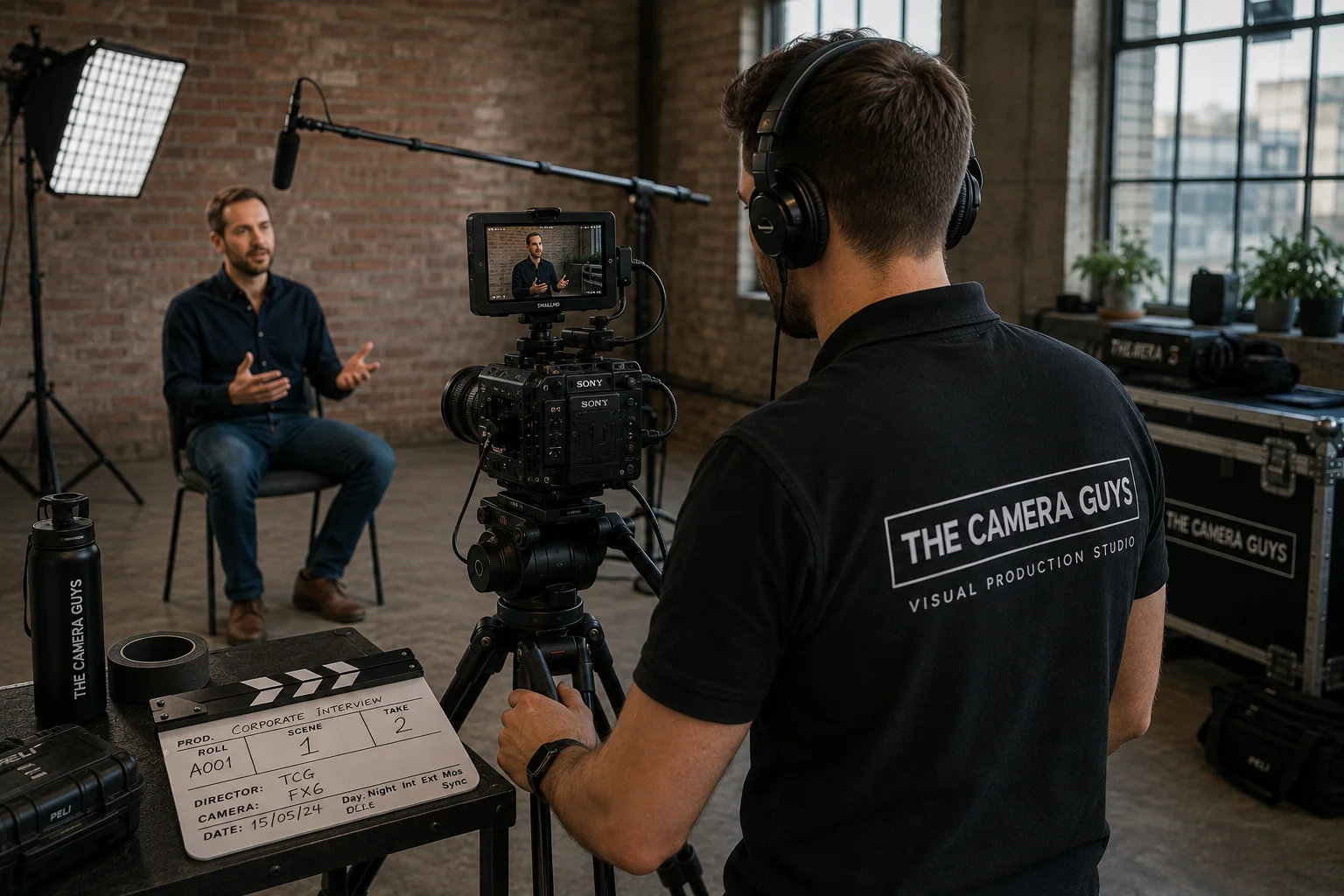
A corporate video can cost less than some businesses expect.
It can also cost considerably more.
Both can be perfectly reasonable.
The problem with asking “How much does a corporate video cost?” is that corporate video describes the purpose of the content, not the size of the production.
A four-hour interview at one office, a full-day process film inside a factory and a multi-location brand film may all end up on company websites under the heading “corporate video”. They do not involve the same amount of work.
At The Camera Guys, the current standard starting rates are straightforward:
| Production item | Current rate |
|---|---|
| First on-location hour | £249 per operator |
| Each consecutive additional hour | £99 per operator |
| Video editing and post-production | £49 per hour |
No VAT is currently added to our prices.
Those rates give you a starting point. They do not mean a finished corporate film has one universal package price.
The total depends on what needs to happen before the cameras arrive, how much needs to be captured, how many people and locations are involved, and what you want delivered afterwards.
If you simply want to move a filming-hours slider and see the current production cost, use our main video production pricing page. We also have a more detailed videographer cost guide with an interactive calculator.
This article is about the bit the slider cannot know:
what sort of corporate production are you actually building?
A four-hour shoot and a four-minute film are completely different measurements
Finished duration is a poor way to estimate production cost.
A four-minute corporate film could come from:
- one four-hour interview shoot;
- a full day filming a process;
- three short visits across several weeks;
- two days at different UK locations;
- several customer interviews;
- a conference plus follow-up interviews;
- hours of supplied archive material.
Equally, a ten-minute presentation recording may require very little creative editing compared with a ninety-second brand film assembled from several locations and contributors.
The number on the video player tells you very little about the work behind it.
That is why a useful corporate quotation should describe the scope, not simply give you a mysterious figure next to the words “three-minute video”.
The easiest part to understand is filming time
For a straightforward one-videographer booking, our current production rate is:
£249 for the first on-location hour, then £99 for each consecutive additional whole hour.
That means the on-location production element for one operator currently works like this:
| Time on location | Production cost |
|---|---|
| 1 hour | £249 |
| 2 hours | £348 |
| 4 hours | £546 |
| 6 hours | £744 |
| 8 hours | £942 |
These figures are filming costs, not finished-video package prices.
Editing, travel and anything genuinely additional to the standard production setup are scoped separately.
That distinction matters.
If somebody tells you a corporate video is “£546”, the useful next question is:
What does that £546 actually include?
With our current rates, £546 is the standard on-location production cost for one operator booked for four consecutive hours.
It does not automatically include an unlimited edit, ten social versions, animation, studio hire, voice-over, travel or every piece of raw footage.
What can you realistically film in four hours?
Quite a lot, when the brief is focused.
Our Sony × AMWORLD corporate testimonial is a good example of the shape of a compact corporate production.
The shoot itself was completed in four hours with one videographer at Sony Europe’s London headquarters.
The production included:
- a two-camera interview setup;
- professional lighting and sound;
- the main interview with Darren from Sony;
- an office tour;
- supporting footage around the people and location.
The finished film runs just over three minutes.
If a new four-hour, one-videographer production were booked today under our current standard on-location rates, the filming element would be £546, before travel, editing and any other agreed requirements.
That is not a statement of what the historic Sony/AMWORLD project was invoiced at. It is simply a useful current-rate example of what a focused four-hour filming block can look like.
A project like this stays efficient because the brief is controlled:
one location;
one main contributor;
one clear story;
no need to move an entire crew across several sites.
If you are planning something similar, our guide to filming natural corporate interviews and B-roll explains how the interview and supporting footage can be planned together.

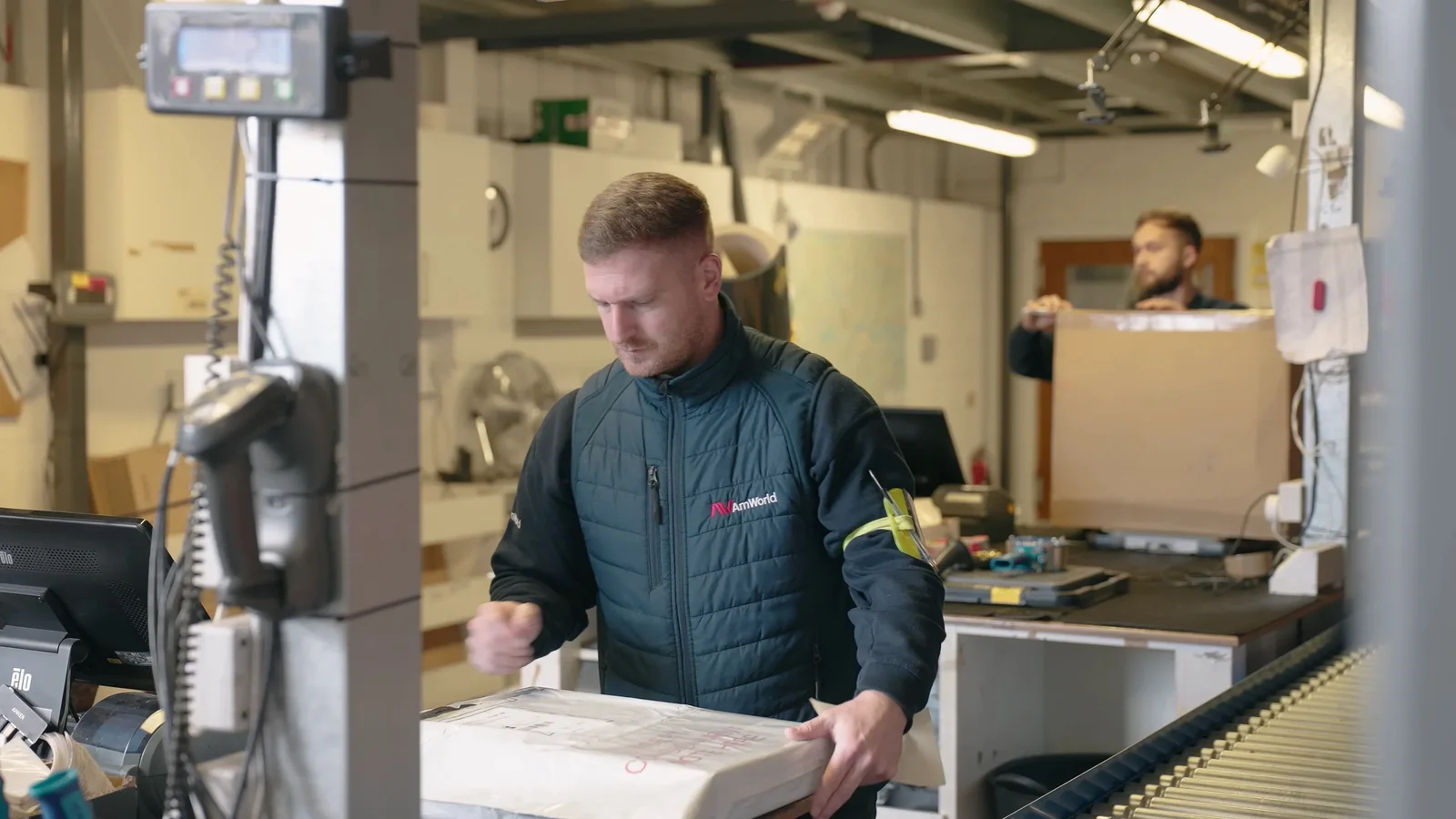
A full filming day gives you more room — but it should have a reason
At the current standard rate, one videographer booked for eight consecutive hours comes to £942 for on-location production.
A full day can make sense when the camera needs to follow a larger process, cover several departments, capture more contributors or wait for activity that happens at different points in the working day.
Our Secure ITAD process film is a useful example of why.
We spent a full day following end-of-life IT equipment through collection, processing, data-erasure activity, secure destruction and recycling.
The film needed to show the workflow, not simply interview somebody who could describe it.
That meant making time for:
- vehicle activity;
- incoming equipment;
- handling and sorting;
- different stages of the process;
- employees carrying out the work;
- detailed close coverage;
- wider context around the facility;
- aerial footage.
A full day is valuable when the story genuinely needs a full day.
It is poor value if the brief only contains one twenty-minute interview and three office shots.
The right question is not:
“Can we afford a full day?”
It is:
“Do we have enough useful material to justify one?”
Our guide to planning a corporate video is designed to answer that before the filming hours are chosen.
Why editing is not automatically linked to filming time
This is the part clients understandably find harder to estimate.
You know whether a crew is on site for four hours.
How are you supposed to know whether the footage needs four, eight or twenty hours of editing?
Usually, you are not.
That is our job to estimate from the brief.
Our current standard video editing rate is £49 per hour, but filming duration does not automatically determine editing duration.
Two four-hour shoots can create completely different post-production workloads.
Four hours of one interview
The editor may need to:
- review the interview;
- identify the strongest answers;
- build the narrative;
- select B-roll;
- clean and mix the sound;
- colour the footage;
- add titles and branding;
- prepare captions;
- make revisions;
- export the agreed versions.
Four hours of a conference with several cameras
The editor may need to:
- organise much larger file sets;
- synchronise cameras;
- synchronise separate audio;
- review long presentations;
- make continuous camera selections;
- build a highlights film;
- prepare individual speaker edits;
- produce social cut-downs.
Same time on location.
Very different editing job.
This is why we deliberately do not ask clients to guess their own editing hours when requesting a quote.
Tell us what finished content you need. We estimate the post-production required to create it.
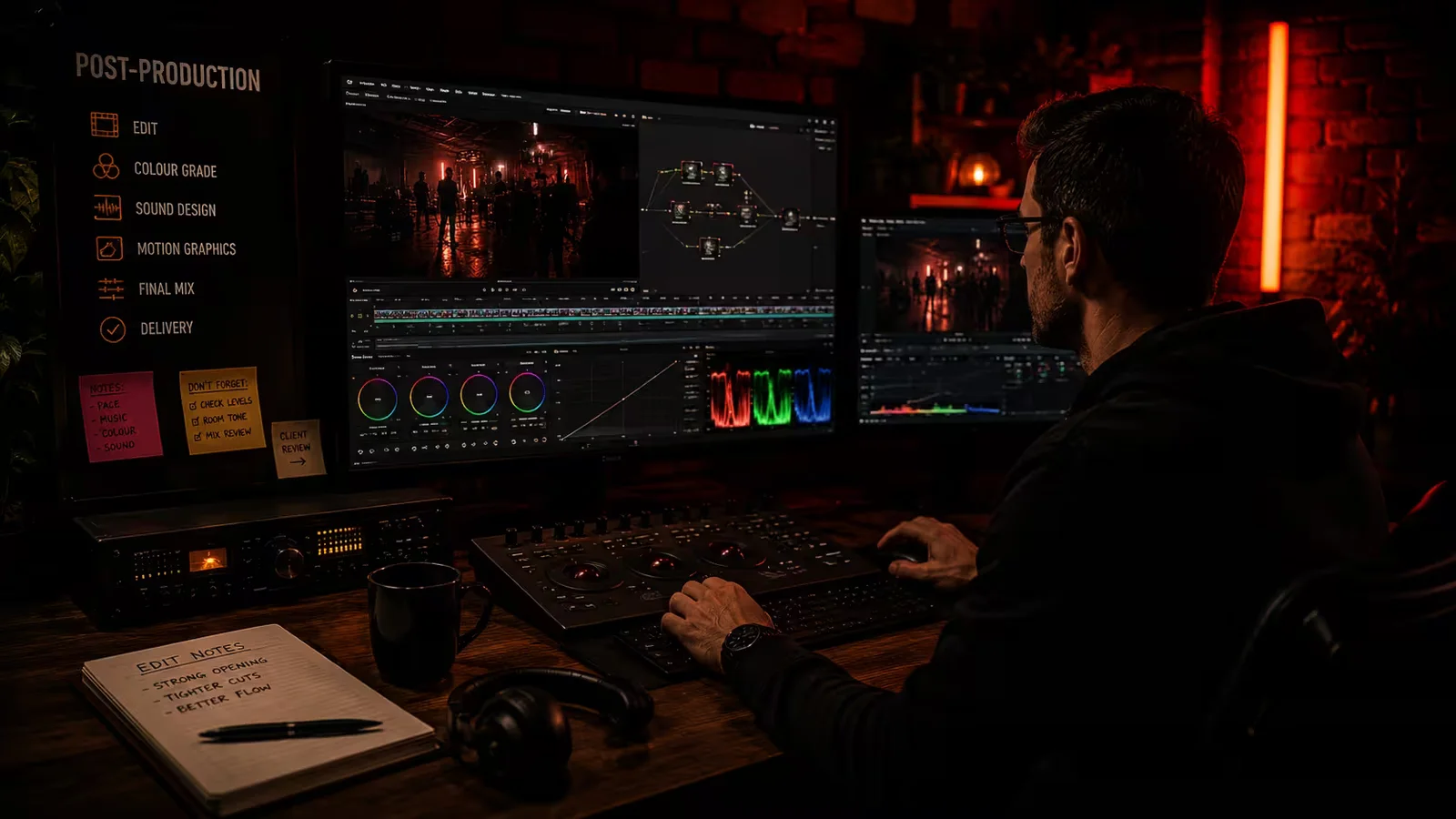
A useful corporate-video budget has at least two separate numbers
When comparing quotes, I would want to understand at least:
1. What does the production on location cost?
and:
2. What does the agreed post-production cost?
Those two numbers answer different questions.
You may also have separate agreed costs for things such as travel, specialist crew or external suppliers.
Separating them makes a quote easier to understand.
It also makes changes easier to price.
If you later decide you need five additional social edits, that is primarily a post-production change.
If the brief changes from one interview to four interviews in different buildings, that affects production as well.
A single unexplained figure hides all of that.
An illustrative £938 corporate-video budget
Here is a deliberately simple example — not a package.
Suppose a small business needs:
- one location;
- one main interview;
- supporting workplace B-roll;
- one videographer;
- four hours on location;
- one main finished film.
The current filming calculation is:
First hour: £249
Three additional hours: £297
Production: £546
If, after reviewing the brief, we estimated eight hours of editing, that would be:
8 × £49
Editing allowance: £392
Illustrative priced subtotal:
£546 + £392 = £938
That still excludes travel and any separately agreed extras.
Again, £938 is not “our corporate video package”.
It is an example showing how a transparent quote can be built from a real production duration and an estimated post-production workload.
A different four-hour film might need much less editing.
Another might need much more.
That is exactly why our interactive videographer cost guide is useful for exploring filming and editing combinations, while an actual quotation is based on your brief.
What pushes a corporate video above that sort of budget?
Usually, it is not one extravagant piece of equipment.
It is scope.
More contributors
One interview can be prepared, lit and recorded within a controlled block.
Six interviews mean six people need scheduling and enough time to give useful answers.
Even if they all use the same chair and lighting setup, the production still needs to record them properly and the editor then has much more material to review.
More locations
Moving from one room to another is relatively easy.
Moving across town is not the same thing.
Moving between counties is something else again.
Every location introduces some combination of:
- travel;
- unloading;
- access;
- parking;
- security;
- setup;
- sound checks;
- lighting changes;
- packing down.
The production needs to budget for the time the crew is doing that, not pretend that cameras teleport between sites.
More finished films
One main corporate film is one deliverable.
A main film plus:
- six interview extracts;
- five vertical social edits;
- a silent website loop;
- a subtitled version;
- two event-screen versions;
is a different post-production brief.
The footage may be shared, which is efficient.
The finished versions still need to be edited, checked and delivered.
More simultaneous activity
If two important things are happening at the same time, you may need more people.
A locked second camera is useful in some controlled situations.
It cannot walk into another room and film a separate interview.
Our guide to single-camera versus multi-camera production explains the difference between adding another camera and adding another camera operator.
Specialist requirements
Some productions genuinely need something outside a normal camera, lighting and audio setup.
That could include:
- drone filming;
- teleprompter delivery;
- dedicated sound personnel;
- additional lighting crew;
- specialist studio or location hire;
- presenters or actors;
- makeup;
- voice-over;
- licensed assets;
- complex motion graphics.
Those things are not automatically expensive for the sake of being “corporate”.
They simply need to be identified and quoted when the idea requires them.
Our pricing page sets out what sits within the standard production rate and which items are agreed separately.
Multiple filming days can be cheaper than forcing everything into one day
That sounds counter-intuitive.
Surely fewer filming days must always be cheaper?
Not necessarily.
Our Opul Life corporate film combined a CEO interview at the company’s Chelmsford headquarters with real community outreach in Chelmsford and Colchester.
The outreach activity naturally took place on different dates.
The production therefore used three shorter outreach visits rather than trying to fabricate the appearance of several genuine community events during one artificial “content day”.
That gave the film:
- different people;
- different environments;
- real conversations;
- more representative footage;
- corporate photography alongside the video.
There is an obvious cost implication to returning to locations.
But there can also be a value argument.
If compressing everything into one day means staging weaker material, the “cheaper” production may create a less useful film.
The best schedule is the one that captures what the story actually needs.
One videographer is enough for many corporate films
Businesses sometimes assume “professional production” means a large crew.
It does not.
One experienced videographer can handle many interview-led and process-led corporate productions efficiently.
Depending on the job, that can include:
- one or more planned camera angles;
- lighting;
- professional location audio;
- interview direction;
- B-roll;
- basic production management.
A compact crew can actually be an advantage in offices, customer locations and community environments.
It takes up less space and can make genuine interactions easier to capture.
Extra people become useful when the work genuinely separates into simultaneous jobs.
For example:
- several cameras need active operation at once;
- an interview needs to run while another part of the site is being filmed;
- several rooms need continuous event coverage;
- a complicated production benefits from dedicated sound, direction or assisting.
The guide to how many camera operators you need goes deeper into that decision.
Do not pay for a large crew merely because you think it makes the invoice look more “professional”.
Pay for the people the production actually needs.
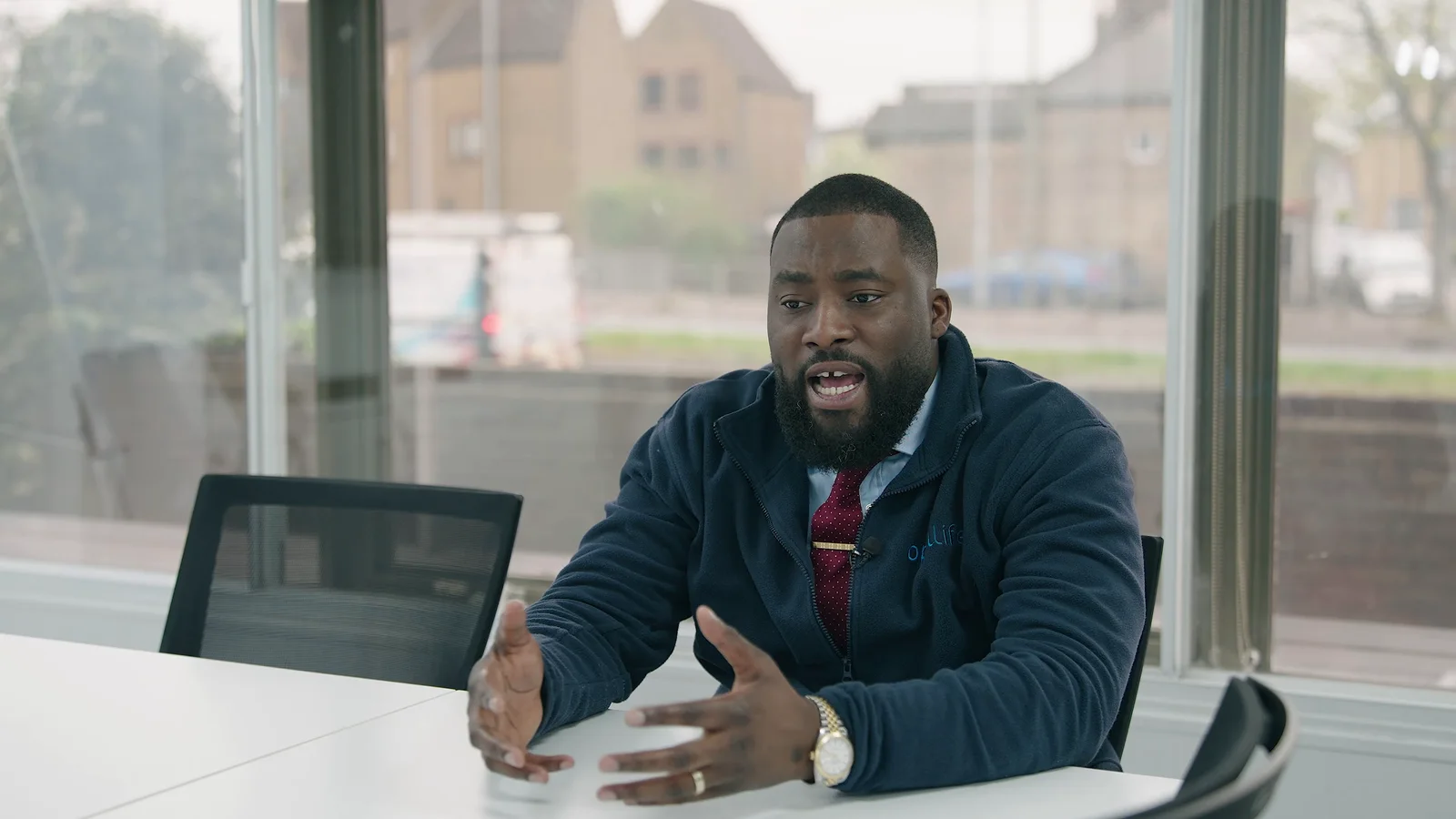

Planning can reduce production cost without making the video look cheaper
There is a big difference between cutting corners and removing waste.
Good preparation can reduce the amount of paid production time spent waiting for avoidable problems.
Before the crew arrives:
- confirm who is being interviewed;
- give contributors actual arrival times;
- reserve the rooms;
- identify noisy periods;
- clear confidential material from shot;
- arrange site access;
- prepare products or demonstrations;
- have current logos and brand files ready;
- decide who will approve the film.
Suppose a four-hour booking loses forty-five minutes because the interview room was double-booked.
Nothing about the camera setup caused that cost.
It was a planning problem.
Our guide to preparing for a corporate video shoot covers the practical things worth resolving before filming day.
A clear brief helps us recommend where to spend the budget
You do not need to know the number of editing hours.
You do not need to know which cameras we should use.
You do not need to decide whether the lighting needs three fixtures or five.
But it is useful to tell us:
- what the business needs the film to achieve;
- who the audience is;
- where the video will be used;
- which people may need to appear;
- which locations matter;
- what finished versions you need;
- when it needs to be ready;
- what budget range you are trying to work within.
Budget is particularly useful when it is a real constraint.
If the business has £3,000, we would rather design a strong £3,000 production than develop a £9,000 concept and spend a week discovering it cannot happen.
That does not mean automatically spending every pound available.
It means making sensible decisions earlier.
For example, if the choice is between:
- a second location that adds very little;
or:
- enough post-production time to create three genuinely useful social versions;
the second may provide far more value to the business.
A good quotation should help make those trade-offs visible.
What should you compare between corporate-video quotes?
Not just the total.
Take two quotes for £2,500 and £4,000.
The cheaper one may be excellent value.
The more expensive one may be excellent value.
You cannot tell from those numbers alone.
Compare:
Filming time
How long is the crew actually booked?
Does the time include arrival and setup?
Crew
How many people attend?
Why are they needed?
Equipment
Does the quote include a suitable standard camera, audio and lighting setup?
Are specialist items genuinely necessary?
Post-production
How is editing being scoped?
What kind of finish is expected?
Deliverables
Exactly what files will you receive?
One film?
One film plus social versions?
Captioned versions?
Vertical versions?
Revisions
How does the review process work?
Our current pricing includes two reasonable review rounds within the original agreed editing brief when editing is quoted. New deliverables, substantial re-edits and changes of direction are additional scope.
Travel and external costs
Are they included, estimated or excluded?
What happens if parking, accommodation, venue fees or specialist suppliers are needed?
Source footage
Do not assume you automatically receive every original camera file.
Our current standard pricing treats RAW/source-file handover separately because preparing and transferring a production dataset is a different deliverable from supplying the finished videos.
A good comparison asks what you receive for the number, not which number is smallest.
Should a corporate video cost thousands of pounds?
It can.
It does not have to.
A focused interview-led film with one videographer, one location and a controlled edit can remain relatively compact.
A multi-day campaign with several locations, many contributors, additional crew, creative development, graphics and multiple finished versions can easily move into the thousands.
Both are “corporate video”.
That is why broad industry ranges are not especially useful on their own.
Saying “corporate video costs £1,000–£20,000” technically covers a lot of reality while helping almost nobody plan a job.
The more useful approach is to identify which production you are actually describing.
What if your budget is small?
Do not try to imitate a large campaign badly.
Reduce the scope.
Instead of:
six interviews, three locations, drone footage, ten social videos and a company film
consider:
one strong interview, one useful location, relevant B-roll and one finished film.
That can still be professional.
It can still look considered.
And it may communicate one important thing far better than a larger brief rushed into the same budget.
You can expand later.
A strong first project can also create reusable B-roll or establish an interview style for future filming.
If regular content is the longer-term goal, batching genuinely related material can reduce repeated setup. Our guide to creating a month of social content in one filming day explains when that approach makes sense.
What if your budget is larger?
Spend it on the brief, not on making the production complicated for appearances.
A larger budget can be useful for:
- more filming time;
- genuine multi-location coverage;
- additional contributors;
- specialist crew;
- more ambitious lighting;
- set or location work;
- detailed art direction;
- higher-end graphics and animation;
- more finished content;
- properly planned versions for several channels.
But those elements should exist because the communication benefits from them.
An expensive drone shot that says nothing about the business is still a pointless shot.
A second filming day that lets us capture the real process at the right time may be extremely valuable.
The money should solve production problems or improve the finished communication.
How can we quote editing if you do not know what you want yet?
Sometimes we cannot — yet.
That is why an early conversation is useful.
You may come to us with:
“We need a film about our company.”
We might then ask:
- Who needs to watch it?
- What should they understand?
- Are there customers or employees we should hear from?
- Is the work visually interesting?
- Where does it happen?
- Do you need one master film or a wider content package?
- Does the business have a deadline?
- What budget are we designing around?
Those answers create the production.
Once the deliverables and likely footage are understood, we can estimate the editing work far more responsibly.
You do not need to invent editing hours simply to receive a quote.
The fastest way to get a useful corporate-video price
Send something like this:
We are an engineering company based in Essex. We need a video for our website that explains a service which customers currently find difficult to understand. We would like to interview our operations manager and film the team carrying out the process at our site. We are hoping to complete filming in one day and would also like three short LinkedIn edits if the budget allows. We need the final content by the end of November and have roughly £2,500–£3,500 available.
That is an excellent starting point.
It gives us:
- the objective;
- audience context;
- likely contributor;
- location;
- likely filming requirement;
- desired additional versions;
- deadline;
- budget.
We can then recommend a practical scope rather than sending back an unexplained package menu.
So, how much should you budget for a corporate video?
For The Camera Guys, the most useful starting figures today are:
£249 for the first on-location hour per operator
£99 for each consecutive additional hour per operator
£49 per hour for video editing
Travel and separately scoped requirements are added where applicable and agreed before booking.
No VAT is currently added.
From there, the complete project depends on the brief.
A focused four-hour shoot has a current standard one-operator production cost of £546.
A full eight-hour day is £942 for one operator.
Editing is then estimated around the footage and actual deliverables rather than automatically multiplying the filming hours by another number.
That is enough information to get a realistic conversation started without pretending every corporate film belongs in the same package.
For a quick filming estimate, use the live pricing page.
For a more interactive breakdown of production and editing, use our videographer cost calculator and pricing guide.
And if you already know roughly what the business needs, send us the brief, even if it is only a paragraph. We can work out the filming, crew and post-production from there.