
How Much Does Video Editing Cost in the UK?
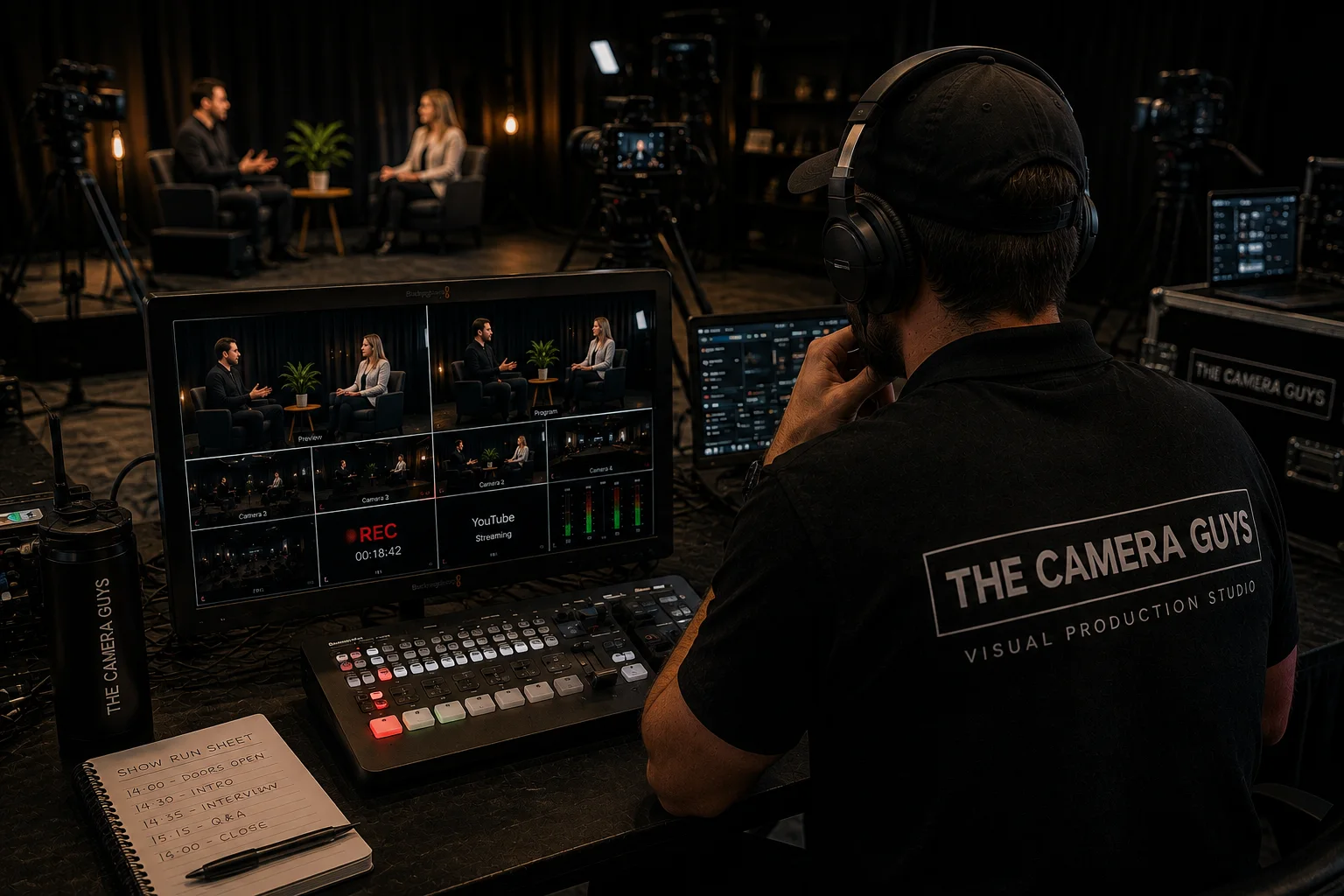
A 60-second film can take longer to edit than a 20-minute presentation.
That sounds backwards until you look at the material behind each one.
The 60-second film might begin with four hours of interviews, footage from two cameras, separately recorded sound, several locations, graphics and three social-media versions. The 20-minute presentation might already be one clean recording that only needs trimming, titles and a straightforward export.
Professional video editing is priced around the work required between the source footage and the approved deliverables — not simply the number of finished minutes.
At The Camera Guys, our current published video editing and post-production rate is £49 per hour. We estimate the amount of editing from the footage, brief and deliverables before confirming the project price. Our current pricing page also states that no VAT is presently added to our prices.
That makes the hourly rate easy to understand.
The more important question is: how many editing hours will your project actually need?
What does £49 per editing hour mean in practice?
Here is the simplest arithmetic.
These are worked examples of our current hourly rate, not fixed packages or promises that a particular type of film will take this long.
| Editing time | Cost at £49/hour | What that number means |
|---|---|---|
| 2 hours | £98 | Two hours of agreed editing work |
| 4 hours | £196 | Four hours of agreed editing work |
| 6 hours | £294 | Six hours of agreed editing work |
| 8 hours | £392 | Eight hours of agreed editing work |
| 12 hours | £588 | Twelve hours of agreed editing work |
| 16 hours | £784 | Sixteen hours of agreed editing work |
| 20 hours | £980 | Twenty hours of agreed editing work |
The table is useful for budgeting once the likely edit time is known.
It is not a shortcut for deciding that a social video must take four hours or a corporate film must take sixteen.
Two projects with the same finished duration can require completely different amounts of editorial work.
Our live video production pricing page should always be treated as the source for current Camera Guys rates.
What are you paying an editor to do?
The word editing can make the job sound like cutting the beginning and end off clips.
Sometimes that genuinely is most of the brief.
Often it is only the start.
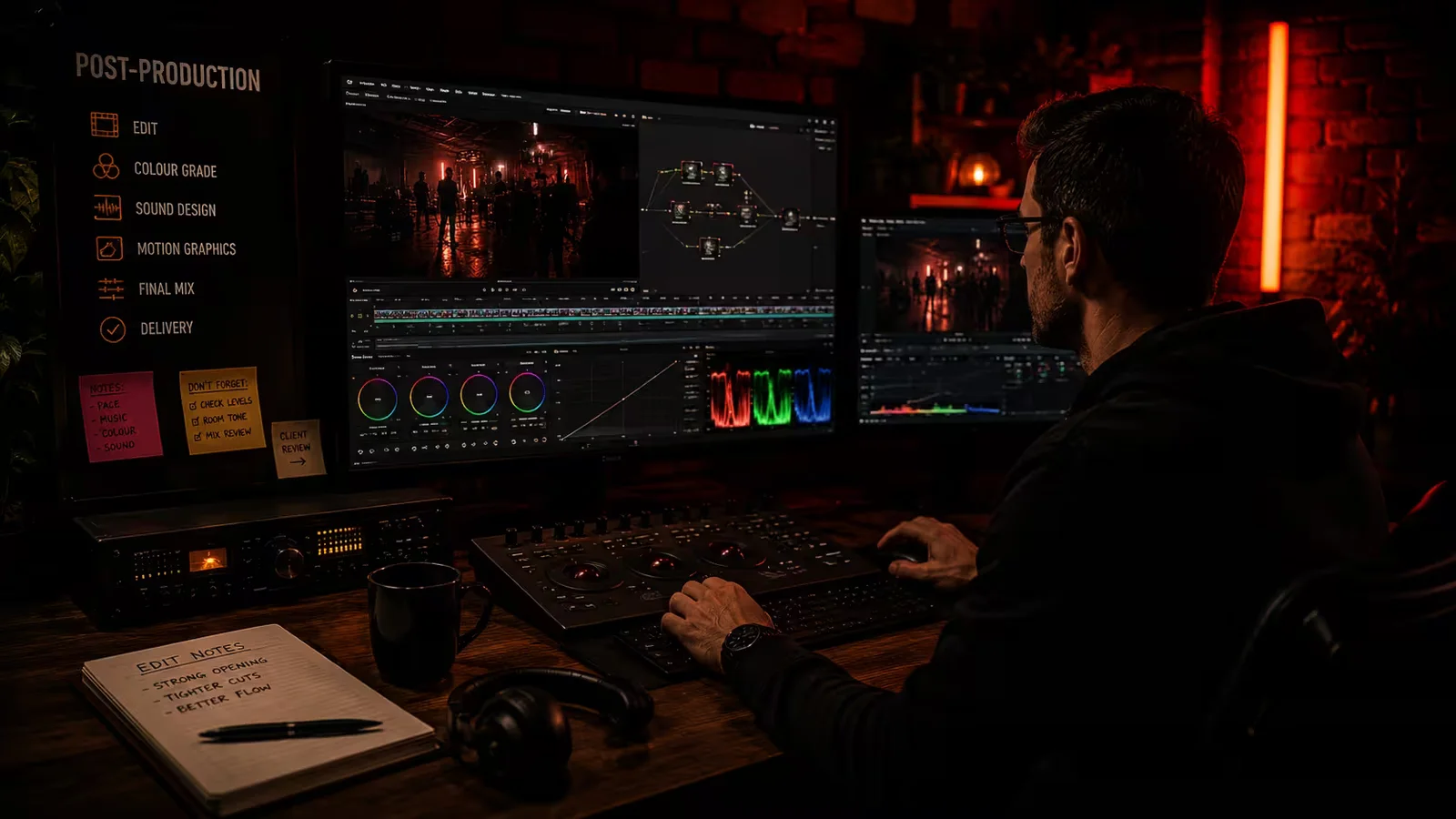
A professional editor may need to:
- transfer and organise the footage;
- inspect formats and identify missing or damaged files;
- synchronise several cameras with separately recorded sound;
- review interviews and identify the strongest answers;
- build a story from material recorded out of sequence;
- choose supporting footage;
- remove repetition and improve pacing;
- repair or balance dialogue where possible;
- choose and edit music;
- correct and match colour;
- create titles and branded graphics;
- add captions;
- create landscape and vertical versions;
- send review copies;
- make agreed amendments;
- export and quality-check every final file.
Those stages sit inside the wider video post-production process.
A client does not necessarily need every one of them.
That is why the scope matters more than the word “edit”.
The fastest edit: the decisions have already been made
Imagine sending an editor one 15-minute presentation.
You provide:
- one camera file;
- clean recorded sound;
- exact timestamps for two sections to remove;
- the approved opening title;
- the approved closing slide;
- one final 1080p landscape file.
There is very little uncertainty.
The editor can inspect the source, make the agreed changes, balance the result, add the supplied graphics, export it and check the finished file.
Now compare that with this brief:
“Here are four hours of interviews and workplace footage. Can you make a really strong 90-second brand film and three social versions?”
The final video is far shorter.
The editor has much more to decide.
They need to find the story before they can polish it.
Interview editing is largely a selection problem
A three-minute customer case study may come from an hour or more of recorded conversation.
Before building the film, somebody has to listen to it.
The editor might find five different answers that make roughly the same point, a useful phrase buried inside a longer response, or an excellent anecdote that only works if another sentence appears first.
A transcript can make searching faster, but it does not remove the editorial judgement.
The editor still needs to decide:
- what the audience needs first;
- which statements genuinely add new information;
- what can be shortened without changing the speaker's meaning;
- which claims need visual evidence;
- where the story begins and ends.
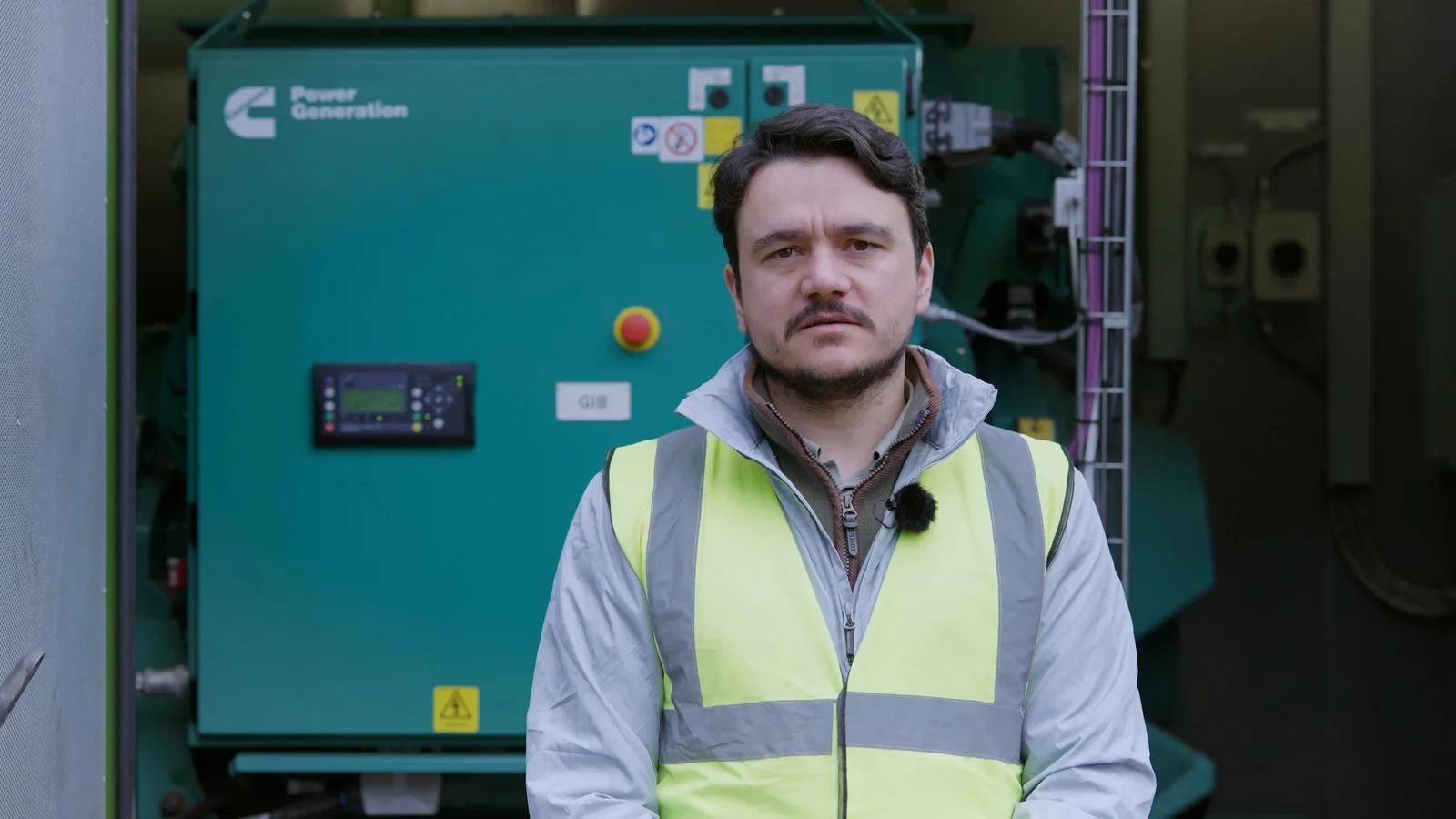
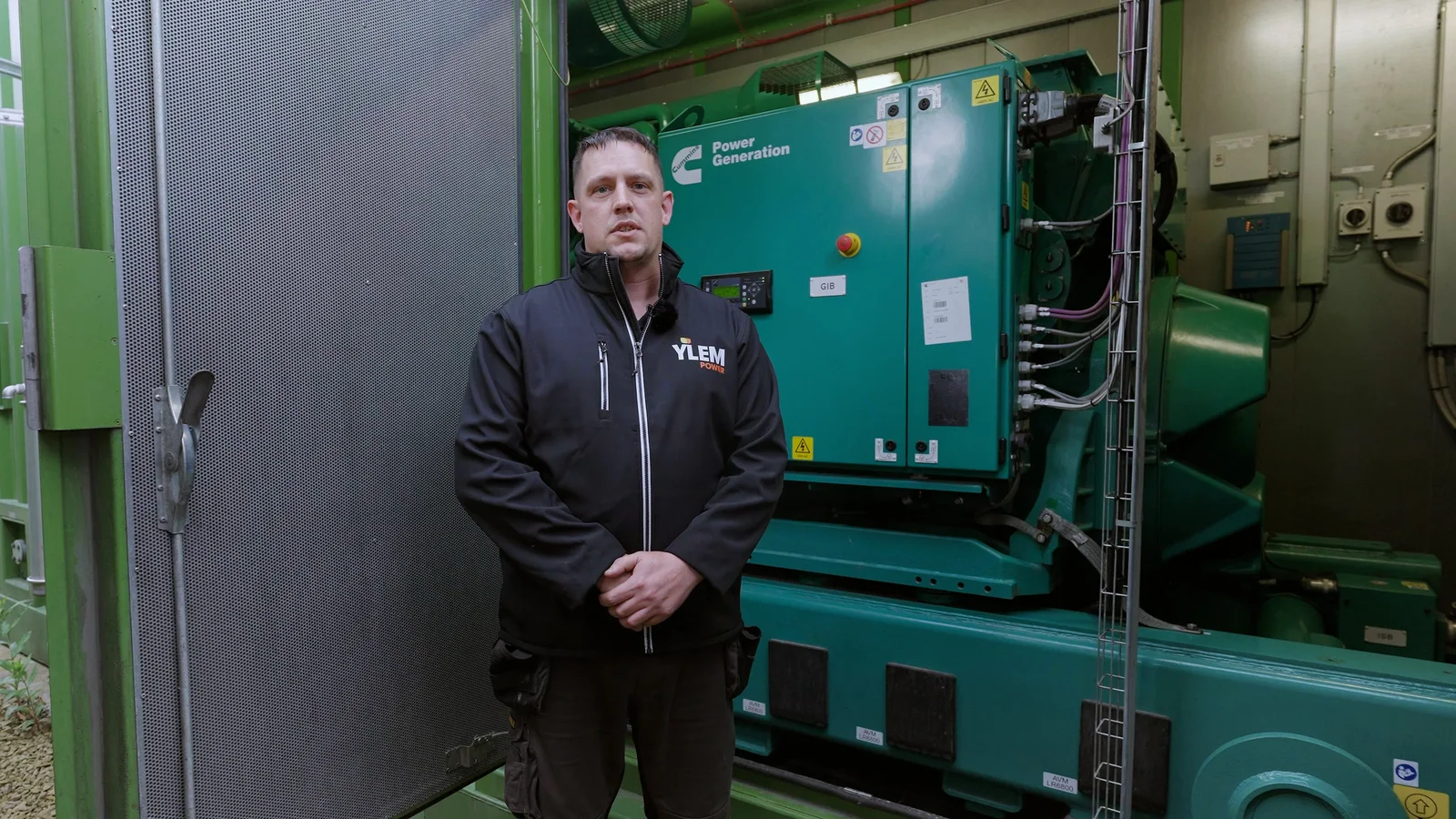
For a project such as our YLEM Terra Firma case study, the finished film brings together customer testimony, YLEM's explanation of its work and extensive site footage.
The interviews supply the meaning.
The surrounding footage gives the editor something real to show while that story is being told.
That is more editorial work than trimming a finished presentation, even if both eventually produce one video file.
More footage does not automatically mean a better film — but somebody still has to review it
The amount of source material can have a major effect on the cost.
Ten useful clips organised into labelled folders are quick to understand.
Three drives containing repeated exports, phone copies, old edits, unused camera cards and files with identical names create another job before the creative edit begins.
Our guide to how much raw footage a video shoot can produce explains why source volume grows quickly when several cameras are recording.
For an editing-only enquiry, tell us approximately:
- how many hours of footage you have;
- how many cameras recorded it;
- whether sound was recorded separately;
- whether interviews are included;
- whether the files are already organised;
- whether there is an existing edit or project file.
A screenshot of the folders can sometimes be more informative than saying “there isn't much footage”.
Multi-camera editing costs more when the cameras create more work
Several cameras can make the finished video more useful and visually varied.
They also create additional source material.
Imagine a one-hour panel discussion recorded by three cameras plus a separate audio recorder.
The editor may need to:
- organise four sets of recordings;
- synchronise them;
- confirm the sound source;
- create or manage a multi-camera sequence;
- watch the discussion while selecting appropriate angles;
- avoid cuts that reveal awkward continuity;
- add any slides, names or supporting graphics;
- correct colour differences between cameras;
- review the complete finished programme.
The programme may still be one hour long.
That does not mean the edit took one hour.
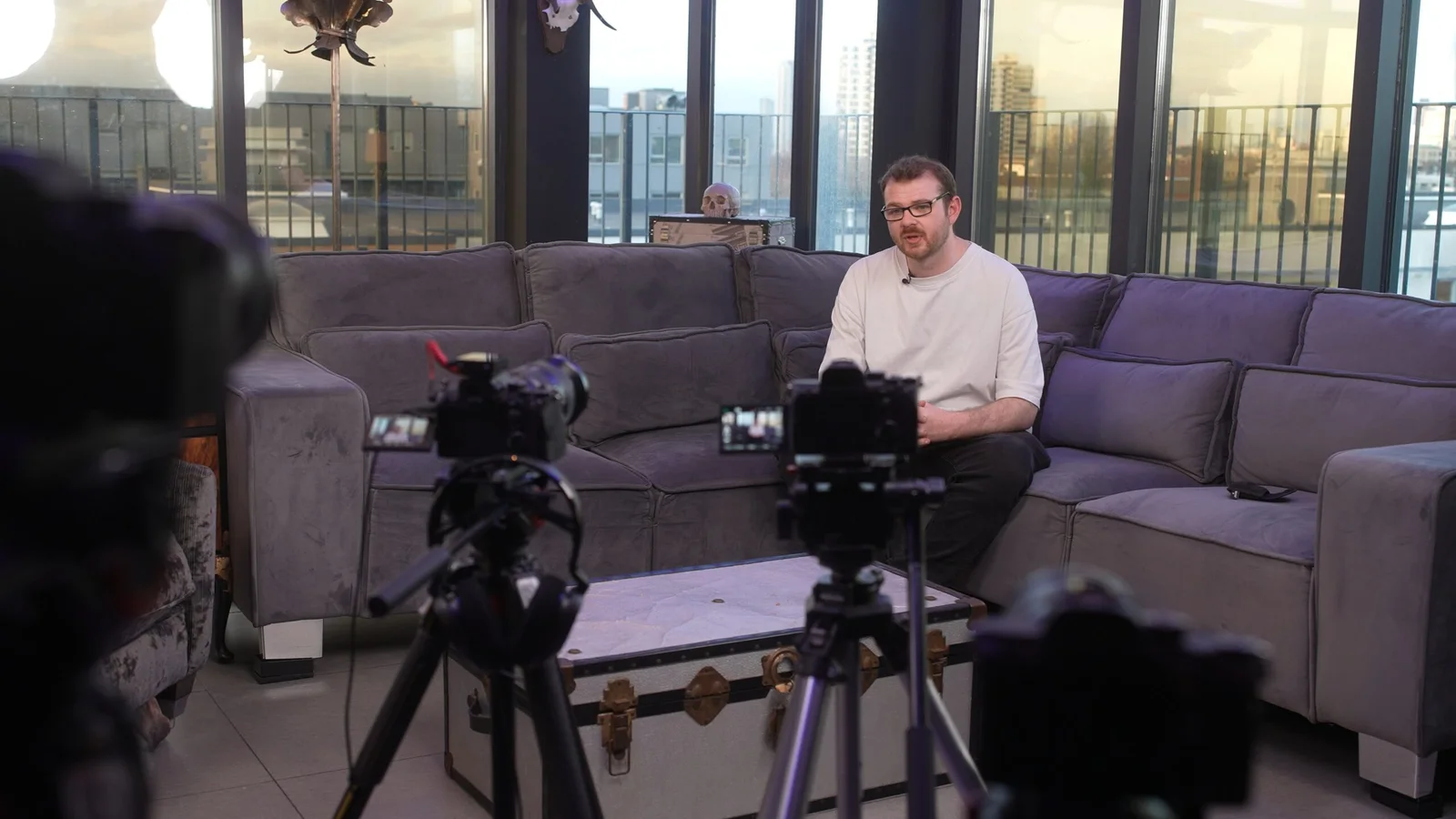
The same principle applies to interviews filmed with two or three cameras. Multiple angles can be extremely useful, but they are part of the editing scope rather than free extra footage.
Graphics can mean anything from a name caption to animation
“Add our graphics” is too vague to price properly.
These are all graphics, but they involve very different amounts of work:
- a static logo at the end;
- a person's name and job title;
- several branded section headings;
- an animated product label following an object;
- a moving diagram explaining a process;
- a screen replacement;
- a custom animated explainer.
Simple branded titles can be relatively efficient once the design is agreed.
Custom motion graphics involve design, timing, revisions and often more specialist work.
If animation is an important part of the film, send references with the enquiry. “Something like this” is much easier to scope when the editor can see what this means.
Sound cleanup has limits
Audio work can include balancing dialogue, controlling unwanted noise, smoothing edits, managing music and making several speakers feel consistent.
It can improve many recordings.
It cannot perfectly reconstruct words that were never captured properly.
Heavy wind, clipping, distant microphones or several people talking over each other can turn an apparently simple edit into attempted restoration — with no guarantee that the result will sound pristine.
Our guide to why professional audio matters explains why good post-production starts during recording.
When you are supplying footage filmed elsewhere, send an original-quality sample if there is any concern about the sound.
Do not base an editing quote on a highly compressed WhatsApp copy if the original recordings are available.
Colour correction and colour grading are not the same as applying a filter
Footage from different cameras, locations or times of day may need balancing before it feels like one film.
Colour correction and grading can involve:
- interpreting the source footage correctly;
- balancing exposure;
- correcting white balance;
- matching cameras;
- protecting skin tones;
- keeping product and brand colours credible;
- creating a consistent visual character.
Straightforward material can be relatively quick to match.
Mixed cameras under difficult lighting, archive footage, phone clips and specialist formats can require more attention.
If exact product colour is commercially important, say so before the grade rather than after seeing the first finished export.
One master film and five deliverables are not the same job
Suppose the main edit is approved.
You then ask for:
- the 16:9 website version;
- a 9:16 vertical version;
- a square version;
- a version with burned-in captions;
- a clean version without captions;
- a 30-second cutdown.
The underlying story is shared, but each file still has work attached.
A vertical version may need different framing. Graphics may need moving. Captions need checking. A shorter edit needs editorial decisions rather than just exporting the first 30 seconds.
Our guide to vertical and horizontal business video explains why orientation is best considered before filming.
List every required version when requesting the quote.
It is much easier to price six known outputs than discover five additional ones after the master film has been approved.


Revisions are normal; changing the brief is different
A first edit exists partly so the client can review it.
At The Camera Guys, where editing is quoted, two reasonable review rounds within the original agreed brief are included, unless the project agreement states otherwise. Our current terms define a review round as one consolidated set of comments on that version.
That might include:
- correcting a job title;
- changing an agreed shot;
- shortening a section;
- balancing a music level;
- correcting a factual point.
It does not automatically mean:
- creating another film;
- changing the entire concept;
- adding new deliverables;
- rebuilding the approved story around a new message;
- creating additional aspect ratios that were not in the quote.
Those are changes to scope.
Additional editing outside the agreed brief is currently charged at the same £49/hour, with the extra work agreed first.
The cheapest revision round is usually one email
If five stakeholders send separate comments, the editor can receive contradictory instructions:
Make the introduction shorter.
We need more context at the beginning.
Move Sarah earlier.
Sarah should be removed.
Put the original introduction back.
That is not really five small changes.
It is a decision-making problem being transferred into the edit.
Nominate one person to collect feedback, resolve disagreements internally and return one time-coded list.
That protects both cost and schedule.
Worked example 1: a straightforward supplied-footage edit
Imagine a client supplies:
- one 12-minute presentation;
- one camera;
- clean sound;
- an approved logo;
- exact instructions to remove three pauses;
- one opening title;
- one final landscape file.
If the agreed editing allowance were 3 hours, the arithmetic at our current rate would be:
3 × £49 = £147
That is not a standard package price.
It simply demonstrates how an uncomplicated brief translates from estimated editing time into cost.
If the footage turns out to contain technical problems or the brief expands, the required time could change.
Worked example 2: an interview-led business film
Now imagine:
- 90 minutes of interviews;
- two cameras;
- separately recorded sound;
- workplace B-roll;
- one 2–3 minute main film;
- branded name captions;
- music;
- colour and sound finishing;
- two included review rounds.
If that specific project were estimated at 10 editing hours:
10 × £49 = £490
Again, the ten-hour figure is hypothetical.
Another interview project might require less. A more complex story could require considerably more.
The useful part is the method:
estimate the work → agree the hours or project scope → apply the rate
rather than:
finished film is three minutes → guess a price per minute
Worked example 3: the main edit is approved, then more versions are added
Suppose a master film is complete and the client later asks for:
- one 30-second cutdown;
- one vertical reframe;
- captioning and checking;
- two additional exports.
If those additions require another 4 hours:
4 × £49 = £196
This is why defining the delivery list early is useful.
The cost is not created by pressing Export four times. It comes from adapting, checking and approving the additional outputs.
Editing footage filmed by somebody else
Yes — we can edit footage that we did not film.
That might be content recorded by:
- your internal marketing team;
- another videographer;
- an agency;
- employees using phones;
- previous production suppliers;
- conference or livestream systems.
The first question is not who recorded it.
It is whether the material is usable for the result you want.
Ideally, supply the original camera files rather than versions downloaded from social media or sent through messaging apps.
Also include:
- the brief;
- target duration;
- examples of the intended style;
- approved logos and brand assets;
- any must-use clips;
- any material that must not be used;
- music or stock licensing information;
- delivery formats;
- the deadline.
Mixed footage does not automatically make a project impossible.
Sometimes the best creative choice is to acknowledge the mixture rather than aggressively crop, sharpen and colour everything in an attempt to pretend it came from the same camera.
Can you reduce editing cost by selecting the footage yourself?
Sometimes.
Useful timestamps can save time when you already know exactly which sections matter.
For example:
00:12:18–00:13:02 — use the answer about installation
00:26:40–00:27:10 — customer result
01:04:05–01:04:20 — wide factory shot
That is much more useful than:
“The good bit is somewhere near the middle.”
But do not create several hours of work for yourself trying to perform the editor's entire job unless that genuinely helps the project.
For interview-led work, you may accidentally exclude the sentence that makes the story connect.
A useful compromise is to identify:
- essential clips;
- unusable material;
- factual priorities;
- strong moments you already know about;
then allow the editor to review the surrounding footage.
Can AI make professional editing dramatically cheaper?
AI-assisted tools can speed up particular tasks.
Transcription can make long interviews searchable. Speech recognition can help create a first caption pass. Object tracking, noise reduction and other assisted features can reduce repetitive work.
They do not remove the need to decide what the film should say.
A transcript still contains every mediocre answer as well as every good one.
Automatic captions still need names, figures and specialist terminology checked.
A generated edit still needs somebody to decide whether the sequence is accurate, appropriate and on-brand.
Use automation where it genuinely removes administration.
Do not confuse automated processing with editorial judgement.
What information do we need to quote an editing-only job?
You do not need to know how many hours the editor will need.
That is what the estimate is for.
Send us:
1. The footage volume
Approximate hours of source material and number of cameras.
2. The footage type
Interviews, presentations, product demonstrations, events, phone footage, drone, screen recordings or a mixture.
3. The finished deliverables
How many videos, approximate lengths and aspect ratios.
4. The intended style
Send a reference if there is one. Explain what you like about it.
5. Graphics
Logos and name captions are different from custom animation.
6. Audio
Tell us about separate microphone recordings, known sound problems or supplied music.
7. The deadline
Especially when the film is tied to an event, campaign or presentation.
8. The current state of the project
Are we starting from camera originals, an existing timeline, a rough cut or an almost-finished film?
A sample of the source footage can reveal more than a long email about its technical condition.
Editing cost and production cost should stay separate
This article is specifically about post-production.
If you also need somebody to plan and film the material, the total budget has other components: on-location production, crew, travel, equipment and any specialist requirements.
Our main guide to UK video production costs explains how those elements fit together.
Keeping the subjects separate prevents a common misunderstanding:
“The videographer costs £X, so the finished film costs £X.”
Filming produces the source material.
Editing turns that material into the finished deliverables.
They are connected parts of the same production, but they are not the same work.
How long will the edit take to come back?
Editing hours and elapsed turnaround are different things.
An eight-hour edit does not automatically mean you send the footage at 9am and receive a finished, approved film at 5pm.
The editor may need to schedule the work, upload or copy large files, send a review version, wait for stakeholder comments, make amendments and create final outputs.
Our guide to how long professional video production takes explains how review periods affect the calendar.
If you have a fixed launch date, provide it before the work is scheduled.
Urgency is much easier to plan than to discover halfway through the edit.
What happens to the project files afterwards?
Delivery normally centres on the agreed finished files.
Raw footage, camera originals and editable project files are separate from the standard final deliverables unless they have been specifically included.
Our current pricing page lists source-file handover separately, and our footage backup and storage guide explains the difference between active project backup and long-term archive.
If you know another editor will need to reopen the project later, tell us before delivery.
A clean master, caption file and well-planned alternative versions can also make future updates easier without handing over an entire production archive unnecessarily.
So, how much should you budget?
For The Camera Guys, the current calculation begins with £49 per editing hour.
The total then depends on what the editor has to do.
A clean, tightly defined supplied-footage edit may need only a few hours.
An interview-led film, multi-camera event, complex graphics project or campaign containing many versions can require considerably more.
Do not begin by asking:
“How much does a three-minute video cost?”
Begin with:
“Here is the footage, and here is what we need to turn it into.”
That is enough for a useful conversation.
If you already have the footage, send us the editing brief. Include the approximate amount of material, the finished videos you need and your deadline. We can review the scope and estimate the editing time before the work begins.