
How Much Does Video Production Cost in the UK?
The price depends on the production, not the finished runtime
There is no single useful answer to the question “how much does video production cost?” because the phrase video production covers an enormous range of work.
A straightforward interview in one location and a campaign filmed across several sites may both result in a two-minute film. They are not the same production, and they should not cost the same.
For a quick estimate of on-location coverage, use our interactive videography pricing calculator. It adjusts the production estimate to the booked hours; editing, travel and agreed extras remain separate.
If you are looking for The Camera Guys’ current filming rates, real project cost breakdowns and the interactive calculator, use our main guide to how much a videographer costs in the UK. That is the page we keep focused on actual numbers.
This guide has a different job: explaining what changes the total cost of a video project, why two apparently similar quotations can be very different, and where to simplify a brief if you need to bring the budget down.
A good quotation should make the work visible. You should be able to understand what is being planned, what happens on location, what will be done in post-production, what you will receive at the end and which costs sit outside the core production.
Start with what you need to receive
One of the easiest ways to get an unhelpful quote is to ask only for “a day of filming”.
That describes attendance. It does not describe the finished job.
Before worrying about cameras or crew size, define the useful output. For example:
One two-minute film for the website, three vertical cut-downs for social media, captions, a clean version without burned-in subtitles and delivery before the campaign launch.
That gives a production company something meaningful to scope. It also gives you a much better basis for comparing suppliers.
A filming day that produces one finished film is a different job from the same filming day producing twelve individual edits, even if the cameras are on location for exactly the same length of time.
If you are still working out what the project needs to achieve, our guide to writing a video production brief will help you define the objective, audience, constraints and deliverables without trying to make technical decisions yourself.
A video-production budget is usually several jobs bundled together
The finished quote may appear as one project figure, but behind it are several different kinds of work.
| Part of the production | What can change the cost | Why it matters |
|---|---|---|
| Planning | Scripting, locations, contributors, schedules, research, approvals | More complex productions need more decisions made before filming can begin |
| Filming | Time on location, number of operators, equipment, number of sites | A longer or more complicated shoot uses more crew time and may require specialist kit |
| Post-production | Footage volume, story construction, graphics, sound, colour, captions | The edit is where raw footage becomes a finished piece of communication |
| Versions | Social cut-downs, different aspect ratios, language versions, clean masters | Each additional output can require its own edit, checks and export |
| External costs | Travel, parking, studios, performers, voiceover, licensed assets, permits | These are project-specific rather than automatically included in filming time |
This is why comparing a “day rate” with the price of a finished production can be misleading. The first may cover the crew being present. The second may include days of work before and after the shoot.
Our corporate video production guide goes through that full process from business case to delivery.
The edit can cost more than you expect — even when the film is short
Finished duration is a poor shortcut for estimating editing work.
A 30-second promotional film can require a large volume of footage to be reviewed, multiple locations to be combined, detailed sound work, graphics, careful product selection and several different social versions.
A longer interview can sometimes be much simpler: one contributor, one room, a clear conversation and a straightforward edit.
The question is not simply how long is the final video? It is what has to happen to the footage before the video is approved?
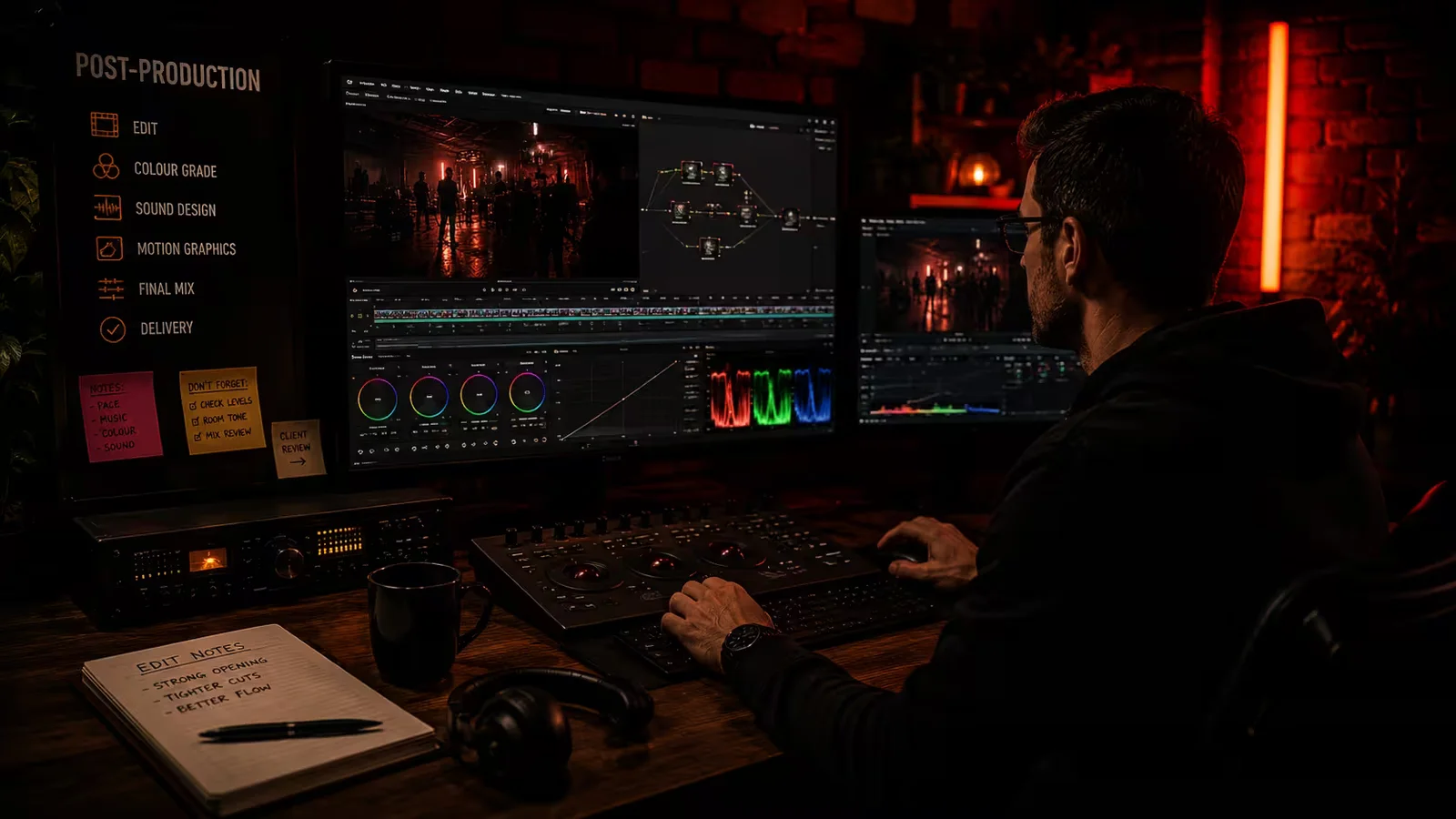
That can include organising media, synchronising cameras and audio, reviewing interviews, selecting takes, building the story, correcting colour, cleaning sound, adding captions, creating graphics, preparing different aspect ratios, handling feedback and exporting the final files.
We have a separate guide to video editing costs in the UK because post-production deserves to be scoped independently rather than treated as an automatic multiple of filming time.
More locations usually mean more than more travel
Adding another location can look simple on paper. In practice, the production may need to pack equipment, travel, find access, unload, set up, check sound and light, film, pack down again and repeat the process.
A ten-minute interview at a second site can therefore consume far more than ten minutes of the production day.
This matters particularly when several locations are included because they “might be useful”. If a second site adds something important to the story, it may be worth the time. If it adds only a different wall behind the contributor, it may not.
Grouping compatible scenes together is one of the most effective ways to make a budget go further. It reduces repeated travel and setup without reducing the quality of the footage that matters.


Extra crew should solve an actual problem
More people do not automatically make a better video.
One experienced videographer can often handle an interview, lighting, sound and several cameras in a controlled setup. Adding a second operator may be unnecessary if there is only one thing happening at a time.
The case changes when the schedule creates simultaneous demands. If a keynote and a breakout session happen at the same time, or an event needs photography and videography in two different areas, one person cannot physically cover both.
The useful question is therefore not “how big is the crew?” but what does each person need to do?
That also makes quotations easier to compare. A production company and a freelancer may propose different crew structures because they are solving the brief differently. Our guide to video production companies versus freelance videographers looks at that decision in more detail.
Creative development can be light or substantial
Some clients arrive with a clear message, confirmed contributors, a location and a good idea of what they need to receive. Others arrive with a business problem and need help working out what the video should be.
Both are perfectly normal.
The second project simply has more work before the shoot.
That might involve developing a concept, researching the subject, writing or refining a script, creating interview questions, planning demonstrations, building a storyboard, finding locations or coordinating several departments.
This is why “pre-production” should not be treated as administrative fluff. Good preparation can save expensive filming time and prevent even more expensive rework later.
A clear brief does not need to tell a production company what lens to use. It does need to explain the audience, objective, deadlines, important contributors, required outputs and any fixed constraints.
Multiple versions should be planned before filming
A common budget change appears after the first edit:
“Could we also have a vertical version?”
“And perhaps six shorter clips?”
“Could we make one without that section for another department?”
Those may all be sensible requests. They are also additional deliverables.
The most efficient time to decide them is before filming. A horizontal website film and a vertical social edit may need different framing. A short campaign cut-down may need a specific sentence or demonstration recorded cleanly. A version for an exhibition screen may need to work without sound.
Planning those uses early allows one shoot to gather the right material for several outputs. Adding them afterwards can mean more editing — or discovering that the footage was never composed for the new format in the first place.
Where a budget can usually be simplified safely
If a quote is higher than the available budget, the best conversation is normally about scope, not asking the production team to perform the same work for less.
Useful places to look include:
- reducing the number of locations where they do not materially improve the story;
- combining compatible filming into one well-planned visit;
- prioritising the strongest deliverables rather than commissioning every possible cut-down immediately;
- simplifying complex graphics or animation where live-action footage can communicate the point clearly;
- confirming contributors and approvals earlier so production time is not lost waiting;
- gathering feedback into one agreed response instead of sending conflicting notes from several stakeholders;
- deciding formats and platform requirements before the shoot rather than rebuilding the project afterwards.
The aim is not to make the video cheaper at any cost. It is to spend the available budget on the parts that affect the result.
Protect the difficult or unrepeatable work first. If a senior customer is available for one hour only, dependable audio matters. If a manufacturing process happens once a month, the crew needs enough time to capture it properly. If a film must play on an exhibition stand, the correct final file matters more than an optional decorative shot.
Cheap filming does not always mean a cheap production
A low filming rate can look attractive until you discover what sits outside it.
The edit may not be included. Travel may be extra. You may need to organise the location, write the script and direct contributors yourself. Revisions may be tightly limited. Captions, graphics, music licensing, social versions or source-file handover may all be separate.
None of those arrangements is inherently wrong. A filming-only service can be exactly what an experienced in-house marketing team needs.
The problem is comparing it with a quote for a managed production as though the two suppliers have priced the same job.
The opposite can happen too. A more expensive quotation may include planning or crew roles you simply do not need. The answer is not automatically to choose the larger scope; it is to understand why it is there.
How to compare video-production quotes properly
Put the quotations side by side and check whether they describe the same finished result.
Look for the agreed deliverables, filming time, number of crew, locations, post-production allowance, review process, travel, specialist requirements, delivery date and any third-party costs.
Anything vague is worth asking about before you make a decision.
“Video production: £2,000” tells you very little.
“One videographer, one location, agreed filming period, one main edit, three cut-downs, captions, two review rounds and delivery in specified formats” gives you something you can actually compare.
The same principle applies to timing. A project can involve only one filming day but still take several weeks from brief to delivery because contributors, editing and approvals happen on different days. Our guide to how long professional video production takes explains that distinction.
So, how much should you budget?
Enough to cover the production you actually need — which is why a useful estimate starts with scope rather than a national average.
For our current filming rates, editing rate, real worked examples and an interactive calculator, go to our main guide: How Much Does a Videographer Cost in the UK?
That article is the best place to explore actual numbers. Our live production pricing page carries the current rate card and service-specific extras.
This article is better used as a checklist for understanding why the quote changes.
If you already know roughly what you want to make, you do not need to calculate every production hour yourself. Tell us the objective, where you expect to film and what you would like to receive. We can work through the filming, post-production and any extras and provide a clear scope before you book.