
How Long Does Video Production Take?
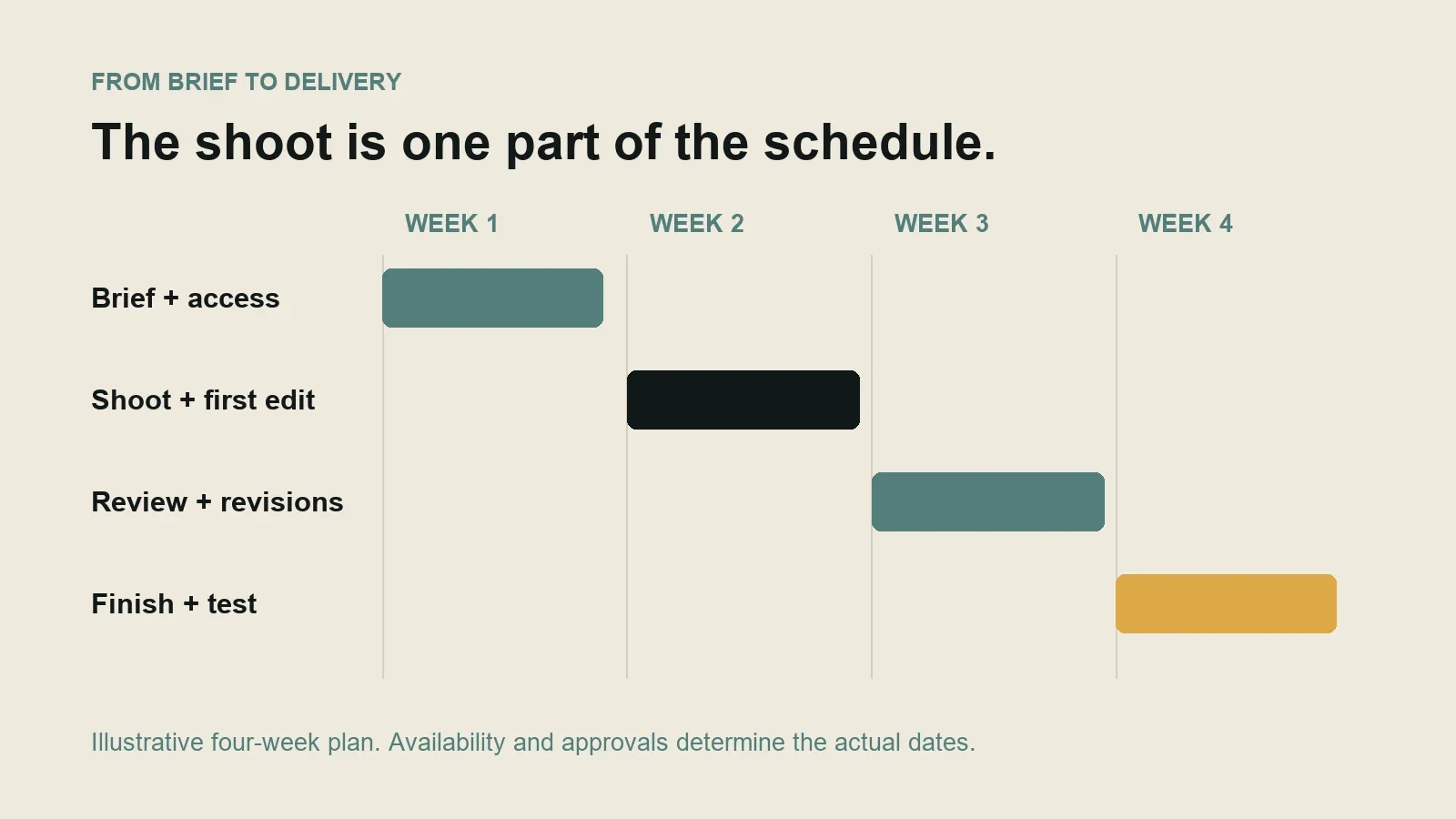
A straightforward business video might be planned, filmed and finished within a few weeks. A larger production involving several locations, multiple contributors, animation or a long approval chain can take considerably longer.
That sounds vague, but there is a reason for it: the finished duration of the video tells you surprisingly little about how long the production will take.
A polished 60-second film could involve several filming days, interviews, drone footage, animation and five different social versions. A 20-minute presentation recorded cleanly in one room may be far quicker to turn around.
For a relatively simple business film, three to four weeks from an agreed brief to final delivery can be a useful planning starting point. It is not a universal industry average, and it is not a guaranteed Camera Guys turnaround. Some projects move much faster. Others genuinely need six weeks, eight weeks or more.
The useful question is not simply “How long will our video take?” It is:
What has to be decided, booked, filmed, reviewed and approved before the final files can exist?
Once you answer that, the schedule becomes much easier to understand.
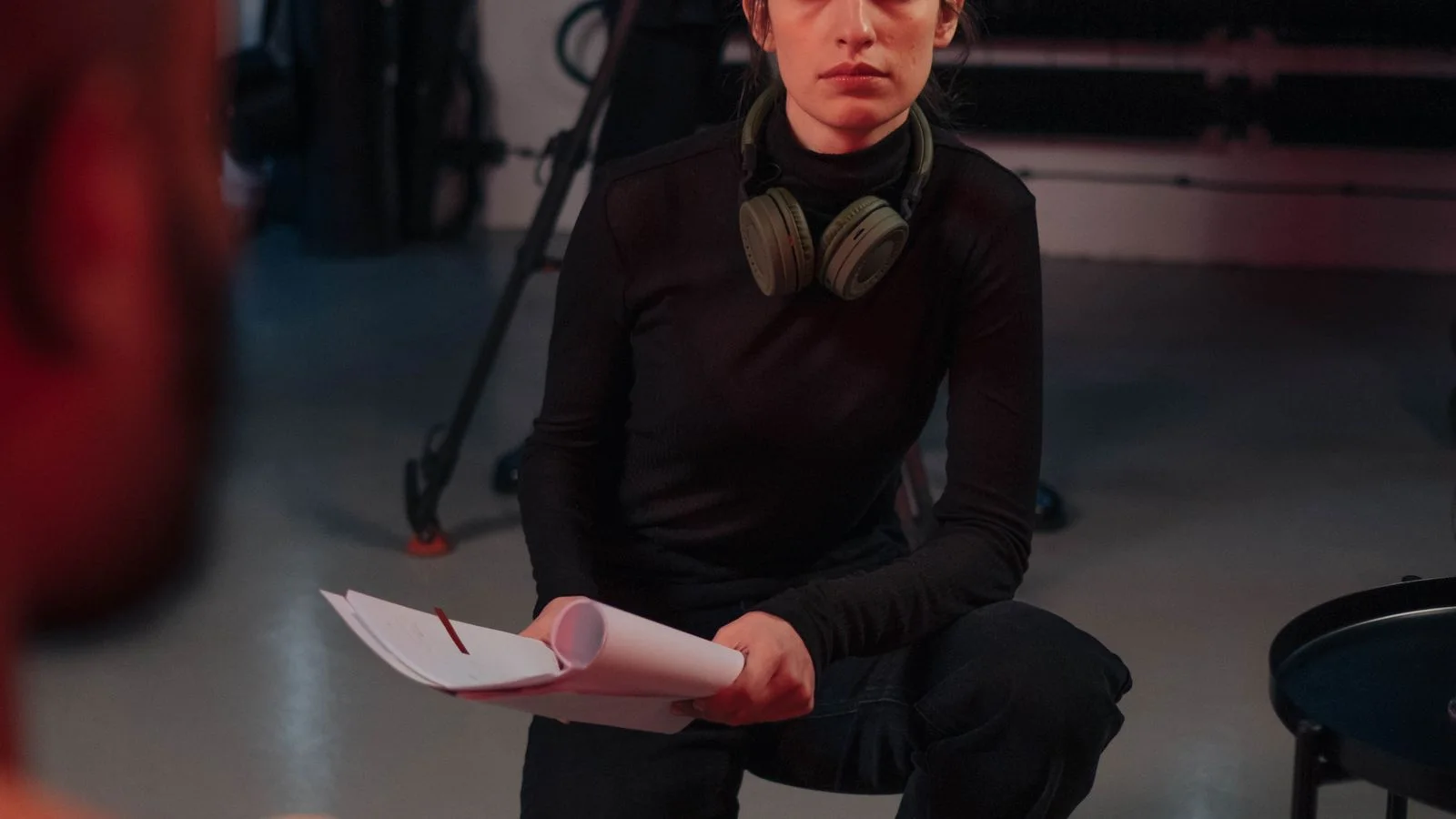
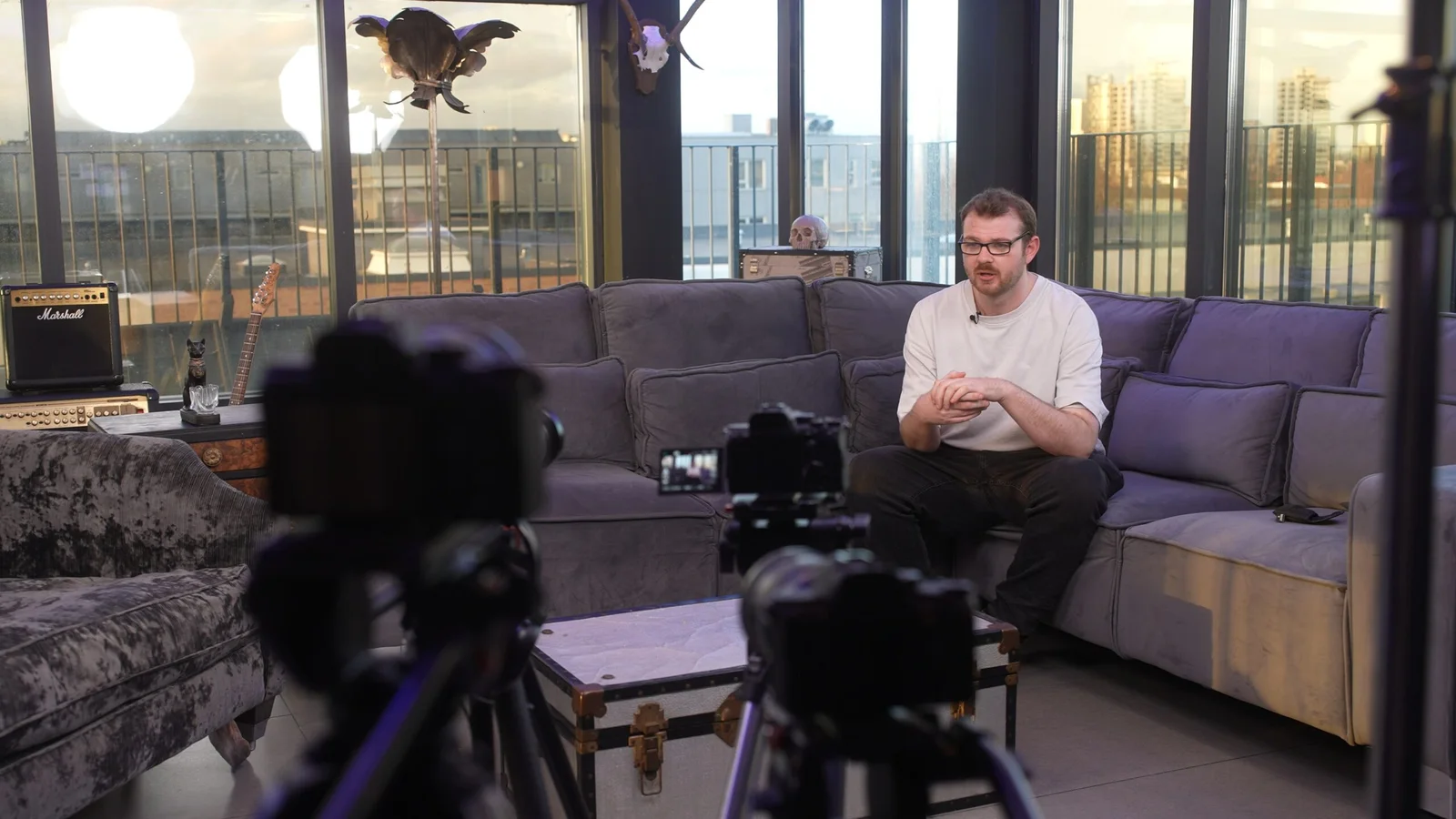
The production timeline is bigger than the filming day
Clients understandably tend to focus on the date when the cameras arrive. That is the visible part of the job, but it is only one stage.
A professional production normally moves through some version of:
Brief → planning → pre-production → filming → media handling → editing → review → revisions → finishing → delivery
The Camera Guys' corporate video production process follows the same principle. The exact amount of work in each stage changes with the job.
For example, an interview filmed at one office might need relatively little pre-production. A campaign spread across several customer sites could require location coordination, contributor schedules, scripts or question planning, travel, releases, multiple filming dates and several people signing off the finished edits.
This is why one filming day does not mean a one-day production.
Likewise, five hours of editing does not necessarily mean the film will be delivered five hours after the footage is recorded. Files need to be copied safely, editing time has to be scheduled, drafts need reviewing, feedback has to come back and final exports still need checking.
A realistic starting point for different projects
The table below is deliberately a planning guide rather than a promise. It assumes the project scope is agreed, the necessary people are available and feedback arrives when expected.
| Project shape | A useful starting window | What needs to be straightforward |
|---|---|---|
| Editing supplied footage into one simple film | Around 5–10 working days | Footage is usable and organised; required graphics and corrections are supplied; one clear approver |
| One-location interview or business film | Around 3–4 weeks | One filming date; contributors and location confirmed; modest graphics; review dates agreed |
| Corporate film with several contributors or locations | Around 4–6 weeks | Access and interview dates can be coordinated; message is reasonably settled; stakeholders are available to review |
| Multi-location campaign with several videos, versions or animation | Around 6–8 weeks or longer | Production dates, specialist work and approval stages can all be scheduled in advance |
These are elapsed project windows, not estimates of billable editing hours.
That distinction matters. A project can contain three days of actual production work but still span three weeks because a customer is only available on a certain date, a director reviews the first edit on Friday, or the final film has to pass a compliance check before publication.
What actually takes the time?
Getting the brief clear
The fastest projects are not always the smallest. They are often the ones where everybody understands what is being made.
Before a reliable schedule can be built, it helps to know:
- who the film is for;
- what it needs to communicate;
- where it will be used;
- who needs to appear;
- where filming will happen;
- what videos and versions need delivering;
- who approves the content;
- and the real deadline.
You do not need to arrive with a finished creative treatment. A rough idea is enough to start a conversation. But unresolved decisions still need time somewhere in the schedule.
Our guide to writing a video production brief goes into this stage in more detail.
Booking people and locations
A camera crew may be available next Tuesday, but that does not help if the managing director, customer, factory line or venue is not.
Contributor availability is often one of the biggest influences on elapsed time, particularly for testimonial and case-study films. The same applies to filming in working environments where access has to fit around production shifts, customers, events or safety restrictions.
Multi-location projects add travel and setup time as well as another set of diaries to coordinate.
This is one reason it is worth beginning the conversation before every detail is final. A production company can often identify which dates and dependencies need protecting first.
Pre-production
Pre-production can be very light or surprisingly substantial.
For a simple interview, it may mainly involve confirming the brief, questions, schedule, location and equipment. A more complex film could add scripting, storyboarding, location reconnaissance, casting, permissions, production documents, safety planning, props, teleprompter copy or specialist crew.
If the film is heavily scripted, the wording normally needs to settle before filming. An interview-led production can sometimes retain more flexibility, although contributors and themes still need planning. Our comparison of scripted and unscripted corporate video explains the difference.
Good preparation is not bureaucracy for its own sake. It is often what makes the filming day efficient.
Filming
A shoot might last a few hours, a full day, several days or happen in stages over a longer period.
The first camera does not start recording the moment the crew walks through the door. Equipment has to be unloaded, rooms checked, cameras positioned, lighting built, microphones fitted and recordings tested. Moving to another room or location can mean doing much of that again.
Real workplaces also introduce pauses: deliveries arrive, machinery starts, aircraft pass overhead, contributors get pulled into meetings and changing daylight alters a setup.
Our guide to what happens on a professional video shoot explains what the filming day actually involves. If it is your first production, the video shoot preparation guide can help prevent avoidable delays before the crew arrives.
Copying, checking and organising the footage
When filming finishes, the footage is not instantly ready for an editor to press play.
Media needs to be transferred and protected. Depending on the production, there may be recordings from several cameras, separate audio devices, drone footage, photography, graphics and client-supplied material.
Multi-camera interviews or events may need synchronising before the creative edit begins. A large amount of footage also takes time simply to watch and understand.
That is another reason finished runtime is a poor predictor of editing time. A two-minute film selected from hours of interviews and observational footage can involve far more editorial work than a longer programme recorded almost continuously.
Building the first edit
The first cut is where the production becomes the film the audience will actually see.
Depending on the job, editing can include:
- reviewing and selecting interview material;
- shaping the narrative;
- choosing and arranging B-roll;
- synchronising cameras and sound;
- music selection and editing;
- graphics and titles;
- audio cleanup and mixing;
- colour correction and grading;
- captions or subtitles;
- animation;
- and creating additional versions for different platforms.
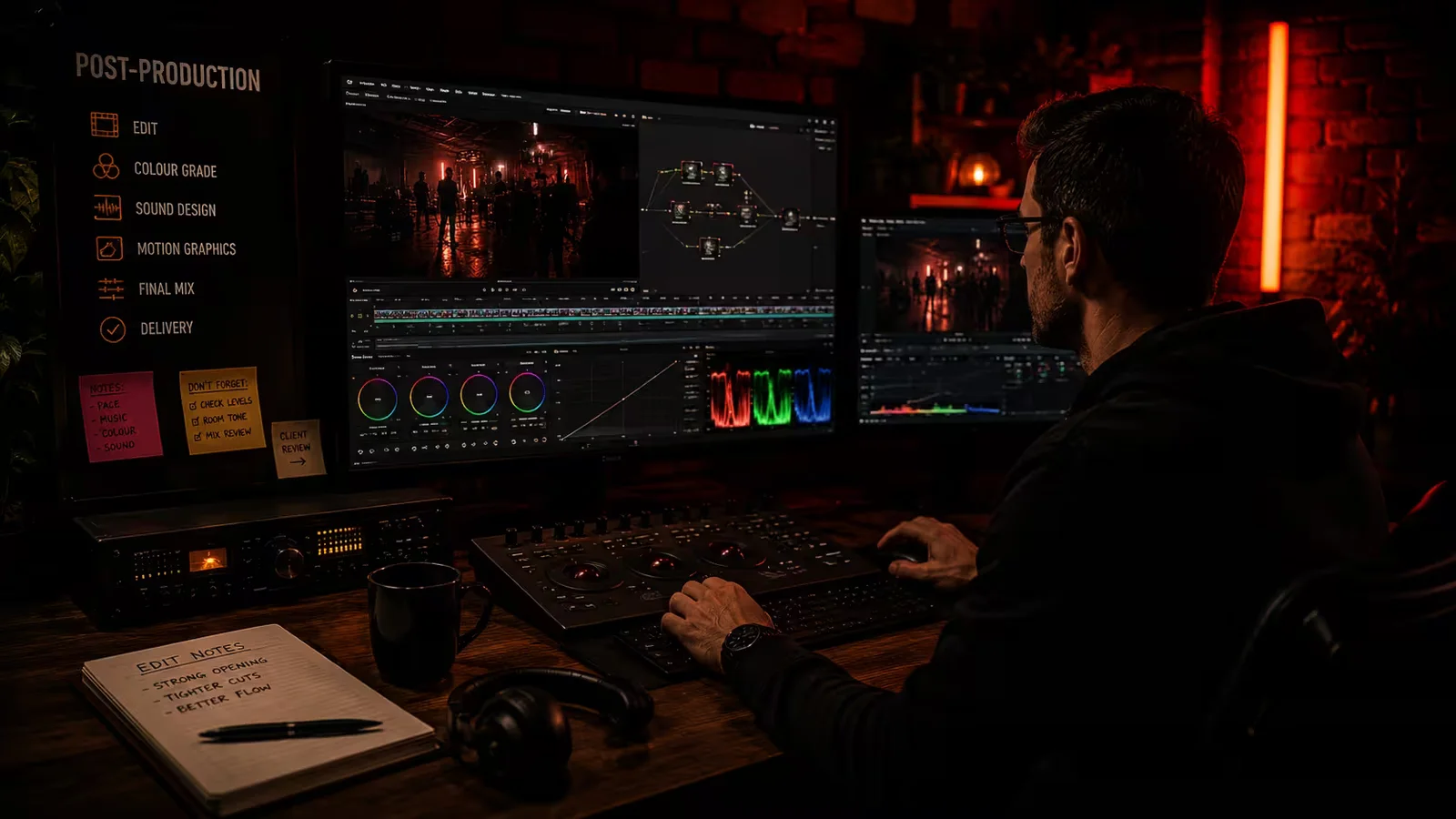
A short social clip can sometimes be edited in a few hours. A substantial corporate film may require several editing days before the first review version is ready.
If you want to understand why post-production varies so much, read our guide to video editing costs and what editors actually do.
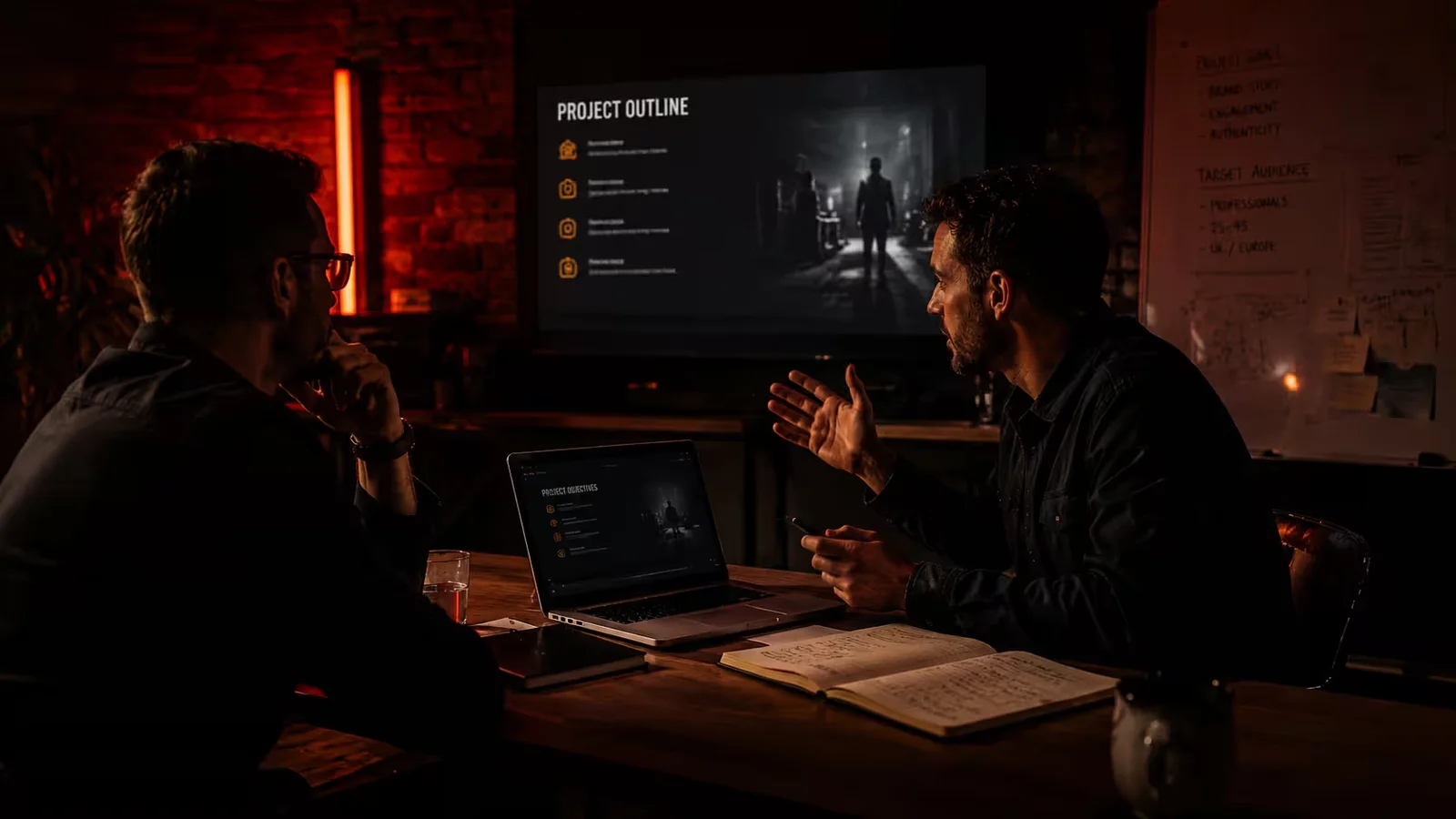
Feedback is part of the schedule
One of the easiest timeline mistakes is to allow time for editing but almost none for review.
Imagine the first cut is ready on Monday. Marketing watches it on Tuesday. The technical team sees it on Wednesday. A director comments on Thursday. Somebody then remembers that legal also needs to approve one statement.
The editor may only need two hours to make the agreed changes, but a week can disappear between drafts.
For that reason, book the review dates when you book the filming date.
Decide who needs to see each draft and nominate one person to return consolidated feedback. Time-coded notes are much easier to act on than several email threads containing different opinions.
There is also a difference between a revision and a change of direction.
Correcting a job title, shortening a section or replacing a shot sits naturally within a review process. Deciding after the first edit that the film needs a different audience, message or set of deliverables can affect both cost and schedule.
Two rounds of clear feedback can move quickly. Five rounds caused by stakeholders arriving one after another usually cannot.
More deliverables mean more post-production
A project is not necessarily finished when the main film is approved.
You might also need:
- a 16:9 website or YouTube version;
- vertical 9:16 clips for Reels, TikTok or Shorts;
- square or alternative social versions;
- captioned and clean versions;
- alternative calls to action;
- shortened exhibition edits;
- different language versions;
- individual interview clips;
- or still frames and supporting photography.
Some versions can reuse much of the master edit, but each one still needs decisions, exports and quality checks. A vertical film may need a genuine re-edit rather than an automatic crop.
If several formats matter, plan them before filming. Our guide to vertical versus horizontal video explains why framing decisions on the shoot can affect the later edit.
A four-week production, worked backwards
Here is a deliberately invented example.
A manufacturer needs a two-minute process film plus two short extracts for an exhibition. There is one filming day, modest branded graphics and two formal review stages.
Rather than starting with the shoot date, start with the moment the approved files actually need to exist.
Week 4: finishing and handover
Thursday: final playback test and delivery. The client checks the approved film on the actual exhibition playback system rather than discovering an incompatible file, muted screen or layout problem during setup on Friday.
Monday–Wednesday: agreed final corrections, sound balance, colour, captions, graphics and exports. The two short versions are checked as standalone videos, including their opening and closing frames.
Week 3: review and refinement
Friday: consolidated second-round feedback is returned.
Monday–Thursday: stakeholders review the first cut and one nominated person returns a single set of time-coded comments. The structure and message are substantially approved before the finishing stage begins.
Week 2: filming and first edit
The process is filmed early enough in the week to allow footage to be copied, checked and reviewed before the editor builds the first cut.
Scheduling a complicated shoot for late Friday and assuming there will be a thoughtful, polished first edit on Monday is rarely sensible.
Week 1: lock the inputs
The audience, contributor times, site access, approved claims, priority processes, brand assets, deliverables and review responsibilities are confirmed.
Any technical wording is checked by the appropriate person before it gets embedded in the edit.
Working backwards exposes something important: the final deadline is only one date in the schedule. Every dependency has its own last sensible date too.
What commonly makes a project take longer?
Some delays come from the production itself. Many come from dependencies around it.
The most common include:
Contributor availability. If the customer who needs to tell the story cannot film for three weeks, adding another editor does not bring that interview into existence.
Location access. Factories, schools, healthcare environments, construction sites and customer premises can have limited filming windows or approval requirements.
Unfinished products or processes. It is difficult to film something that is not ready, installed or operational.
Late scripts or factual approvals. If exact wording matters, approving it after the shoot can create reshoots or awkward fixes.
Large amounts of source footage. More cameras and longer recording periods give the edit more material to organise and review.
Complex graphics or animation. Bespoke motion design adds its own production and review stages.
Difficult audio restoration. Professional audio recording reduces problems, but significant repair work can add time and still cannot recreate everything that was never captured properly. We explain this further in why professional audio matters.
More deliverables. One master film and ten platform-specific edits are not the same post-production job.
Slow or contradictory feedback. Production can only move as quickly as the decisions needed for the next stage.
Scope changes. Adding a new film, message, location or audience after work has begun may need a revised schedule.
Can video production be turned around quickly?
Sometimes, yes.
A genuinely urgent project can move quickly when the scope is controlled and everyone involved is available to make decisions. The wrong way to create speed is to remove checks that protect the result.
If the deadline is close, simplify the variables first:
- use one controllable location where possible;
- choose contributors who are actually available;
- agree one primary deliverable;
- supply approved logos and wording immediately;
- nominate one decision-maker;
- reserve review time in advance;
- and agree which additional versions can follow after the main film if necessary.
Do not create speed by skipping audio checks, safe data handling, factual review or final playback testing. Delivering a broken file on the correct date is not a successful turnaround.
If an event, campaign or product launch has a fixed date, tell the production company at the beginning. That allows the creative approach to be designed around reality rather than compressed at the end.
Three different kinds of “time” to keep separate
When discussing a production, it helps to distinguish three things that are often accidentally treated as the same number.
Filming time is how long the crew is physically capturing the material.
Production work is the amount of planning, filming, editing and finishing required.
Elapsed project time is the calendar period from the start of the job to approved delivery, including bookings, waiting for contributors and client review periods.
A four-hour shoot could lead to several days of editing. A project containing only a few days of actual work might span a month because those days need to happen in a particular sequence.
When you receive a schedule or quote, make sure you know which kind of time is being discussed.
How to keep your production moving without rushing it
The best way to shorten a video-production timeline is usually to remove unnecessary uncertainty before it becomes a delay.
Have the right people available. Confirm access. Approve factual claims. Provide usable brand assets. Know the required deliverables. Reserve stakeholder review time. Return one set of feedback rather than several competing versions.
Most importantly, tell the production company what date actually matters and why.
If the video needs to be live at 9am on the day of a conference, the final master should probably exist before that morning. If a third-party media buyer needs files four days before a campaign begins, that is the production deadline.
The launch date is not always the delivery date.
So, how long should you allow?
For a straightforward business video, a few weeks is a sensible conversation to start with. Three to four weeks can work well for a controlled one-location production when contributors, feedback and deliverables are straightforward.
For projects with several locations, many contributors, animation, complex post-production or multiple stakeholder approvals, allow longer. Six to eight weeks may be entirely reasonable, and larger campaigns can extend beyond that.
Equally, some tightly defined jobs can be completed faster.
The right schedule is the one built around the actual production rather than an arbitrary promise based on the finished runtime.
If you already have a launch date, send us the deadline, filming locations, likely contributors and the videos you think you need. We can work backwards from there and tell you what is realistically involved.
You can also explore our professional videography, read the complete corporate video production guide, see current video production pricing, or talk to The Camera Guys about your project.